Saturday, May 13, 2017

Is Technology Changing Our Brains #5 Bedtime and Sleeping Patterns


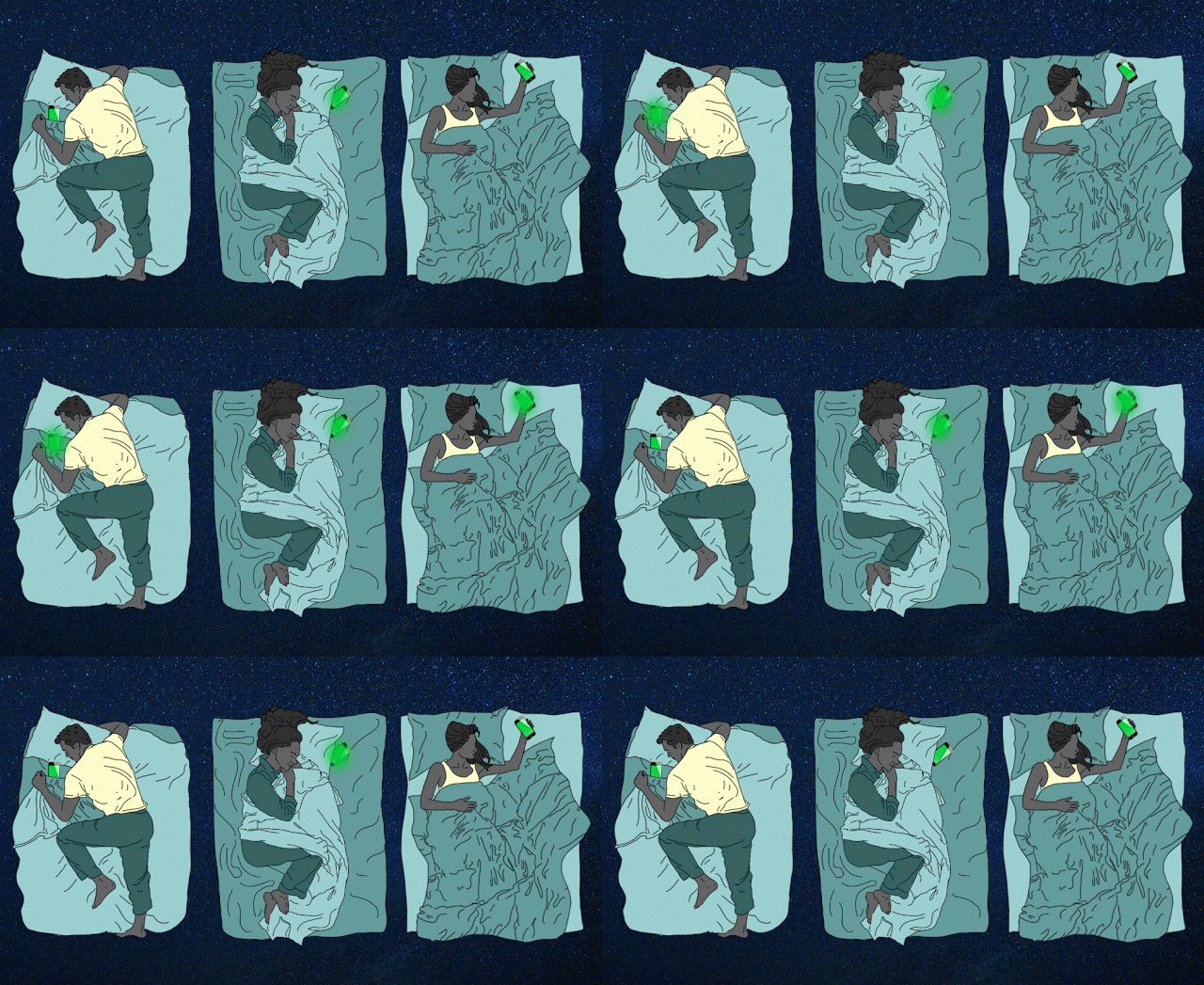
We now spend more time on our devices than we do sleeping. According to an August 2015 Ofcom survey, we engage in media or communication activities such as texting or gaming, for 8 hours and 41 minutes daily, and sleep for 8 hours and 21 minutes.

Technology keeps us up for two reasons. First, we are stimulated by the content. Second, the LED screen emits blue light, which prevents the brain from producing the sleep hormone melatonin. The blue light is in a bandwidth one sees in everyday sunlight, explains health education expert Dr Aric Sigman. “The blue light from your phone or tablet informs your pineal gland that its morning and it should shut down production of melatonin.”

In the journal Preventive Medicine (2016) researchers found a strong association between social media use and sleep disturbance, and warned of a link between sleep deprivation and depression. Sleep deprivation has also been associated with obesity and poor academic performance.
(Summarized from BBC Earth Magazine (Vol.9 Issue 1), page 32 by Jo Carlowe)

Verdict: Screen use at bedtime will change your sleeping patterns
Lord, Give Us Today Our Daily Idea(s)

Is Technology Changing Our Brains #4 Hello, Social Skills Bro


Throughout the world – in caves, huts and houses – it was almost a reflex to turn your face to a returning parents,” explains health education expert Dr Aric Sigman. But, he says, kids are now so glued to their screens they no longer look up.

Though some parents might be glad of the respite that screen-time provides, research suggests that excessive screen use seems to damage our ability to interpret faces. “They [excessive internet users] find it more difficult to read faces in experiments,” explains Sigman.

In one study, children showed a significant improvement in reading facial emotions after spending 5 days away from all devices. In another experiment, Chinese psychologists scanned the brains of ‘normal’ versus ‘excessive’ internet users, while they viewed images of faces and objects. The internet junkies showered smaller brain wave responses to faces than their peers.

Sigman’s view is that technology use itself isn’t damaging – just like sweets, it’s simply a case of ensuring children don’t consume too much, too often. Prof Mizuko Ito of the University of California, meanwhile, believes that a reasonable serving of new media can actually be beneficial for the development of youngster’s brains.

Young people who are taking advantage of online tools like search, forums, open educational resources and complex games are learning at a more accelerated rate, and in specialties that they would never have had access to in earlier eras,” she argues.

However, she adds that for disengaged kids in distressed circumstances, digital media can be a distraction from positive learning and social engagement. “It’s not the availability of media that determines this, but whether they have life opportunities, positive peer influences and caring adults who support and guide them to positive media engagements.”
(Summarized from BBC Earth Magazine (Vol.9 Issue 1), page 32 by Jo Carlowe)

Verdict: New media is just a place to ‘hang out’, but for the socially disengaged there are risks
Lord, Give Us Today Our Daily Idea(s)

Is Technology Changing Our Brains #3 Bad Memory, Maybe


With phone numbers, routes and facts just a touch away, we’re becoming less reliant on our memory – and German neuroscientist Manfred Spitzer warns this ‘cognitive offloading’ could be leading to a kind of ‘digital dementia.’

Studies on internet and gaming addicts has uncovered atrophy (shirking) in the brain’s grey matter, says the University of Bedfordshire’s Prof James Barnes. Overdosing on technology seems to cause the frontal lobe – a brain area that governs functions such as planning and organizing – to suffer in particular. However, he adds that more research is needed on ‘real’ as opposed to ‘addicted’ internet users.

Digital offloading may also make memories less vivid. A US study asked museum visitors to photograph exhibits and just look at others. The next day their memory was tested. Visitors were worse at recognizing objects they had photographed, and worse at recalling details about the objects they’d photographed.

But Dr Sam Gilbert, of University College London, says there are also positives. “Research shows that when you save information to an external store like a computer, this can help you to store new memories. Your mind is no longer cluttered with information that you don’t need.
(Summarized from BBC Earth Magazine (Vol.9 Issue 1), page 31 by Jo Carlowe)

Verdict: Short-term changes are likely but more research is needed on long-term impact
Lord, Give Us Today Our Daily Idea(s)

Is Technology Changing Our Brains #2 Moody Media-Users


Scientists have been reporting strong links between heavy internet use and depression, with a particular focus on social media. This came as no surprise to health education expert Dr Aric Sigman, who says high exposure to social media can leave people feeling inadequate. “There is a relationship between the amount of time you spend on social media and increased body dissatisfaction. High consumption of idealized images seems to activate neural networks in the brain like the amygdala, associated with fear and anxiety.”

Sigman cited a study in which girls who instant messaged their mothers released the stress hormone cortisol, rather than the feel-good hormone oxytocin associated with face-to-face interaction. “We may be hard-wired to need a certain amount of contact with people we care about. A deficit in human contact may result in health problems.”

Facebook, it seems, might not be giving us enough facetime.
(Summarized from BBC Earth Magazine (Vol.9 Issue 1), page 31 by Jo Carlowe)

Verdict: Technology can affect mood, but it depends how we use it
Lord, Give Us Today Our Daily Idea(s)


Is Technology Changing Our Brains #1 May I Have Your Attention Please!


Phones buzzing with text messages, Facebook notifications and news alerts continually tempt the world to distraction. Many experts believe that this incessant bombardment, and the need for instant answers, has eroded our ability to focus.

A 2015 study by Microsoft surveyed 2,000 Canadians and used electroencephalograms (EEGs) to watch the brain activity of a further 112 people. Their analysis found that the average human attention span had dropped from 12 seconds in the year 2000 to just eight seconds. Goldfish are thought to possess an impressive nine-second attention span.

This wasn’t just a company chasing a catchy headline. The research in the area is mostly anecdotal, but a number of surveys do back up the idea that attention spans are shrinking. In a 2012 Pew Research Center survey of more than 2,000 teachers in the US and Puerto Rico, 87% reported that their students had short attention spans and were easily distracted. The same year, UK poll from the learning company Pearson reached the same conclusion. Of 400 UK English teachers questioned, and 2,000 parents of preschool and primary-aged children, 7 out of 10 said that children’s attention spans were shorter than they used to be.

Meanwhile in the US, the Centers for Decease Control and Prevention has reported that 11% of school-age children have, at some point, been diagnosed with Attention Deficit Hyperactivity Disorder (ADHD). Before 1990, the figure was less than 5%.

These studies shine a spotlight on our diminishing attention spans, with modern technology in the crosshairs as the culprit. More research is needed if we’re to be sure of a causal relationship, but experts feel certain they’ll find one. “I am personally convinced that technology has led to a decreased ability to focus and wait, and an increased need for immediate information,” says neuroscientist Prof Russell Poldrack, of Stanford University.
(Summarized from BBC Earth Magazine (Vol.9 Issue 1), page 30 by Jo Carlowe)

Verdict: Yes, the information age has shortened our attention span
Lord, Give Us Today Our Daily Idea(s)

Top 10 Most Read Idea(s) Last 7 Days

Idea-Labels

Thinking Creative Question Action Change Your Life Essential Thinker Series Focus Positive Secrets of the Millionaire Mind Harv Eker Success Attitude Choice Learning Nurture Creativity Play Mindset Perspective Time Experience Habit Observation Curious Different Failure Hardworking How-to Generate Ideas Imagination Problem-Solving Wealth 12 Rules for Life Children Inspiration Jordan Peterson Relax Rich Break the Rules Change Perseverance Reading Risk-Taker Seeing Albert Einstein Barriers to Creativity Confidence I Wonder Series People The Subtle Art of Not Giving A F*ck (Mark Hanson) Connection Happiness Money Possibilities The 7 Habits of Highly Effective People Thought With Winning In Mind Asking Books Character Characteristics of Creative Person Is Technology Changing Our Brains Knowledge Practical Process Writing Believe Challenge Childlike Criticism How to Choose Optimism How to Nurture Your Child to Be Creative Innovative Listening Purpose Relationship Responsibility Story of Idea Thomas Edison Value 7 Climate Facts You Need to Know Communicate Control Enjoy Freedom Fun Idea-Quote Meaning Mistakes Open Mind Opportunity Optimistic Original Resourceful Roger von Oech Talent As A Man Thinketh Combination Commitment Discovery Don't Give Up Dream Energetic Environment Friendship Genius Give Up Growth Leonardo da Vinci Picture Playground Quiet Space Random Reason Start With Why (Simon Sinek) Steve Jobs Understand Walk Wisdom Yew Kam Keong Ability Ambiguity Behavior Crazy Daydreaming Decision-Making Example Facts about Creativity Faith Fear Feeling Goal Hearing Humour Improvement Independence Intuition Isaac Newton Lead Love Motivated Nature Non-Conformist Passion Potential Respect Savor Life Self-Image Stephen R. Covey The Power of Habit Word Alternative Application Awareness Common Blocks to Creativity Conversation Discipline Dynamic Emotion Encouragement Expectation Feedback Flexibility Idealistic Jack Foster Leader Logic Mindful Music Negative Performance Persistence Physical Reinforcement Result Right Answer Sixth Sense Society Talking The Human Body Tony Buzan Vincent Ryan Ruggiero Vision Adventurous Appreciate Attention Be Yourself Beautiful Christopher Columbus Conscious Daring Desire Edward de Bono Empathy Excuses Exercise Financial Galileo Goodness Hardship Help Henry Ford How to Be Innovative Humble IQ Jesus Kindness Laugh Let's Get Started! Memory Mental Rehearsal Michael J. Gelb Multitasking Nicolaus Copernicus Patient Pen and Paper Planning Power Praise Prejudice Proactive Progressive Quality Reality Recording Rejection Routine Sharing Simplicity Sleep Social Media Stand Firm Starbuck Stimulate Strength Stress Studying The Internet Theology Think like A Fool Touching Unpopular Usefulness Victor Hugo What If Win-Win Zig Ziglar 6 Common Creative Killers 9 Types of Intelligence A. Samad Said Affirmation Alexander the Great Aristotle Association Assumption Austin Kleon Balance Benedict de Spinoza Benjamin Franklin Bette Nesmith Graham Bill Gates Blessing Brainstorming Business Carpe Diem Chaos and Order Cicero Colonel Sanders Compliance Concentration Contribute Copernicus David Hume Descartes Desiderius Erasmus Development Diversity Don't Try Download Drug Elaboration Eleanor Roosevelt Enthusiasm Error Ethics Eurika Experiment Explore Extrovert Fluency Francis Bacon Free Book Generalist Giving Back Heroes Hopeful Hormones How to Spark Your Creative Mind How-to Maximizing a New Idea Howard Schultz Hunting Illustration Information Integrity Intention Interruption Introvert Investment James Webb Young Jason Mraz Jean-Jacques Rouseau Jim Carrey Jogging John Locke Jurgen Wolff Juxtapositions Legacy Leon Ann Mean Leon Trotsky Light Liquid Paper Machiavelli Management Manifestation Manipulation Marcus Aurelius Mark Zurkerberg Martin Luther Marty Neumeier Maturity Mental Mihaly Csikszentmihalyi Mind Maping Miracles Mission Statement Modeling Money Blueprint Mood Move On My Top 17 Book on Innovative and Creativity Lists Navigation Skills Niccolo Machiavelli Offline Ontology Ordinary Pablo Picasso Pain Paracelsus Paradigm Paradox of Creative People Parenting Passive Income Peace Perception Philosophy Plato Political Practice Priority Privacy Procrastination Productivity Promote Pythagoras of Samos Rational Rebellious Receiving Reformer Rene Descartes Resilience Resource Myopia Rest Reverse Robert Korn Running Safe Saving Say No Scientific Method Scott Belsky Self-Gratification Selling Seneca Skeptic Slow Down Smelling Social Skills Socrates of Athens Soichiro Honda Specialist Spider-Man St Anselm St Augustine of Hippo St Thomas Aquinas Steal like An Artist Stubborn Suffering Synergize Tasting Technology Thales of Miletus The Creative Environment The Empiricist The Mozart Effect Thomas More Tok Nan Toy Tradition Truth Uniformity Unique Universe Unorthodox Volunteer Walt Disney Wildlife Wonder Xenophanes of Colophon