Showing posts with label Story of Idea. Show all posts

Sunday, April 24, 2016

Leonardo da Vinci's Unquenchable Curiosity and Acute Observations


Helen Gardner, in her book Art through the Ages (1970) writes of Leonardo da Vinci’s “unquenchable curiosity,” and we see this reflected in the 13,000 pages of his famous journals, in which he made a daily record – in notes, drawings, and scientific diagrams – of his observations and studies. These notebooks cover a wide range of interests and phenomena, from human anatomy and facial expressions to animals, birds, plants, rocks, water, chemistry, optics, painting, astronomy, architecture and engineering.

Biographer Daniel Arassa recounts just how far da Vinci would go to try to understand everything around him. On one occasion, the great man coated the wings of the fly with honey to find out if this would change the sound of its buzzing noise in flight. Observing that the note produced by the fly was lower than usual, he attributed this to the fact that the ballasted wings were beating the air less rapidly than before. Thus, da Vinci concluded that the pitch of a musical note is connected with the speed of the percussive movement of the air.

Da Vinci’s acute observations led him to think about and try to solve problems that hadn’t been seriously considered before. Nobody, for example, was asking for a parachute, a car, a submarine, a hang glider, a diving suit, a helicopter, a calculator, or floating shoes and stocks for walking on water, but Leonardo da Vinci invented, or at least conceptualized, these things.

He also came up with military innovations like the machine gun, the armoured tank, the finned mortar shell, a giant crossbow, a triple-barrel cannon, and a mobile bridge. He sketched mechanical breakthroughs such as a steam engine, a hydraulic pump, a reversible crank mechanism, a flywheel system, ball bearings, a hoisting machine, a more accurate clock, an automated bobbin winder, a lens-grinding machine, and a machine for testing the tensile strength of wire. He designed the world’s first canal lock system, a method for excavating tunnels through mountains, a 720-foot (220 m) single-span bridge, a new kind of musical instrument, a double hull for ships, an industrial use for solar power, and a fully functional robot (which he built and displayed for his patron, Ludovico Sforza, at a celebration in Milan in 1495).

Da Vinci,” writes Rowan Gibson, “was able to spot unmet needs and innovation opportunities because he was vastly more observant and more engaged with his environment than others. He was focusing his attention on issues and frustrations that most people simply ignored.”
[Quoted from The 4 Lenses of Innovation (2015) by Rowan Gibson. Title mine]
                                                                                                                    
Lord, Give Us Today Our Daily Idea(s)


Friday, August 7, 2015

Self-Esteem and Creativity: An Example of Walt Disney


In my opinion, most creative-successful people in life are those who retain a strong belief in their own worth and value, even when they have few material possessions to sustain them. They hold fast to their dreams and believe in the validity of their ideas, their belief being stronger than the rejection or acceptance of them by other people. 

When Walt Disney had a new idea he would ask ten people at random what they thought about it. If they all gave negative responses, he would start working on his idea immediately. Walt Disney had many rejections to deal with during his lifetime as a result of seeing things differently from other people and putting everything he had into his dreams. When Walt Disney was trying to find people in Hollywood to give him financial backing for an early cartoon, Mickey Mouse in Steamboat Willie, he was bankrupt. It is hard to imagine just how difficult it must have been in the days of silent films to sell anyone the idea of a talking mouse with a funny voice. However, children and adults around the world today continue to appreciate the wonderful films and magical theme-parks created by this remarkable dreamer.

So was Walt Disney a better human being when he was bankrupt and still doing the original voice of Mickey Mouse, or after he had made all those marvelous films and created those magical theme-parks? Walt Disney had the kind of self-esteem that enable him to persevere long after others would have stopped trying. He had a self-sustaining confidence in his own abilities and dreams, and clearly understood that real value resides in the doer and not in the deed.


Lord, Give Us Today Our Daily Idea(s)

Monday, February 23, 2015

Bill Gates: A Noble Creative Genius


William Henry "Bill" Gates III or simply known as Bill Gates is an American business magnate, philanthropist, investor, computer programmer, and inventor. He founded the world's largest software business, Microsoft, with Paul Allen, and subsequently became one of the richest men in the world. For me, he is not only a creative genius (no doubt!) that has changed the world of digital we live today but also a man who is very generous with his money.

As his billions have grown, Bill Gates has become dedicated to using his money for good causes. Together with his wife, he founded the Bill and Melinda Gates Foundation, an organization that works to bring learning and health to all the people of the world. At present, the foundation has committed more than $300 million to global health; more than $300 million to education, bring computers and Internet access to less prosperous people throughout the United States and Canada; more than $54 million to community projects in the Pacific Northwest; and more than $29 million to special projects and other charity campaigns.

Gates explained, “Giving is a complex thing. You have to find things you really believe in and that are fun to give to. I take philanthropy very seriously and I am learning about it.” Bill and Melinda Gates hope the money they have earned through their work will help to improve the lives of others.

As the keynote speaker at the Forbes 400 Summit on Philanthropy 2012, Bill Gates end his speech this way: “…Melinda and I have the honour and the responsibility to return to society, in the best way we know how, the resources we have received. But you do not need to be the chair of a large foundation to have an impact on the world. Risk takers need backers. Good ideas need evangelists. Forgotten communities need advocates. And whether your chief resource is volunteer time or hard-earned dollars, for a relatively small investment catalytic philanthropy can make a big impact. For me it’s proven the best job in the world, as thrilling and humbling as anything I’ve ever done.”

Noble creative people like Bill Gates are very much needed in the world today.

Lord, Give Us Today Our Daily Idea(s)

Friday, January 30, 2015

Story of Idea #4: How Mark Zurkerberg Passed his Exam by Using the Internet


Founded in 2004, Facebook’s mission is to make the world more open and connected.
People use Facebook to stay connected with friends and family,
to discover what’s going on in the world, and to share and express what matters to them
(Facebook’s Mission Statement since 2012)

Currently I’m reading Don Tapscott’s Grown Up Digital (a great book indeed!) and he told a story about Facebook founder, Mark Zuckerberg. In January 2004, Zuckerberg had a real-life version of a common nightmare. He was facing his first round of exams at Harvard University and he hadn’t studied or read anything the professor has assigned for a first-year art history course called Rome of Augustus. Zuckerberg hadn’t even gone to class during the term. He was too busy creating a cool computer program called Facebook that would help students get to know one another and share information. Now, a few days before the exam, Zuckerberg was, in his words, “just completely screwed.

But he had an idea, straight out of twenty-first century computer science. He created a Web site and put pictures from the course on it, with a little discussion beside each picture. Maybe the other students could help out by filling in the blanks. Within 24 hours, Zuckerberg’s classmates helped out alright, with notes so cogent that everyone, Zuckerberg included, passed the test with flying colours. And according to Zuckerberg, the professor didn’t see it as cheating. Instead, he was “really pleased” to see the students collaborate in such a creative fashion.

After acing his art history test, Zuckerberg returned to his school project, Facebook, which has since become one of the most popular social networking sites in the world; on it, friends and acquaintances keep up with each other’s news. Zuckerberg know how to use social network and the Internet alright. He know how and why is it for, namely, to use it to connect and share information, to find and collaborate on projects or ideas of mutual interest. Do you know how to use social network and the Internet for good cause? Learn from Zuck. These are his and his team original ideas.


God, Give Us Today Our Daily Idea(s).

Thursday, January 29, 2015

Story of Idea #3: Soichiro Honda Never Lack of Resource


Innovation creates a resource. There is no such thing as a ‘resource’ until man finds a use for something in nature and endows it with economic value. Until then, every plant is a weed and every mineral just another rock” (Peter Drucker)

Soichiro Honda was always fascinated by things mechanical. However, he was not the academic type. At 28, he joined a technical high school to pick up the theories in engineering needed to help him is his endeavours. Nonetheless, he chose only to attend the classes that he wanted to. His principal was not too amused about that and promptly dismissed him. That did not discourage him. Instead, it fired him up and he succeeded in manufacturing sound and functional devices.

Immediately after the World War II, Japan was immobilized by a severe fuel shortage. Honda could see that there was no point in driving cars. He solved the problem by attaching a motor to a bicycle. Using a small gasoline engine that had been used for electrical generators during the war, he created the world’s first motorcycle, which is today the ubiquitous mode of transportation in the less developed nations.

Because of the governmental restrictions on gasoline and the manufacture of gasoline-using machines, Honda substituted pine resin, which he recalled had been used a temporary aircraft fuel towards the end of World War II, for gasoline. Since then, Honda had never looked back.

He turned a temporary problem into a long-term global demand. In fact, he was so passionate about the motorbikes that he created the Dream, a sleek and powerful motorcycle with a four-cycle engine. As he said later: “We do not make something because the demand is there. With our technology, we can create demand; we can create the market. Supply creates its own demand.” The name ‘Honda’ is now seen not only on motorcycles but also on cars and other vehicles. It is a name that spells quality.
Reference: I Can Cre8! (Prentice Hall, 2001) by Peter Leong. Page 15-16

Lord, Give Us Today Our Daily Idea(s)

Saturday, February 22, 2014

Story of Idea #2: Albert Einstein the Scientist had the Mind of a Child


I am enough of the artist to draw freely upon my imagination.
Imagination is more important than knowledge. Knowledge is limited.
Imagination encircles the world” (Albert Einstein)

When Albert Einstein was interviewed on the source of his creative genius, he was purported to have replied, “It was because I’m mentally retarded.” Is it possible that one of the greatest geniuses who ever lived was mentally retarded?

Fortunately, Einstein explained what he meant. Einstein had the mind of a child but the brain of a scientist. Like a child, he was constantly asking probing questions which adults regarded as ‘silly’ like: “What will happen if I ride on a light beam?” Incidentally, it was this question that led to his discovery of his famous Theory of Relativity.

In essence, Einstein never grew up. He retained his childlike curiosity. That was why he considered himself “mentally retarded.” Unlike a child, however, Einstein was able to answer his own questions because he had the knowledge and creativity of a scientist.

Another quality of Einstein was that he imagined in pictures rather than using the language of words in his thinking. Every language carries with it inherent limitations that restrict thinking. For instance, the definition of the word “atom” as an indivisible part of matter restricted thinking about the structure of atoms for many years. Words have limitations. Thinking visually and escaping from our linguistic limitations enriches our imagination.

Therein lies a secret to creativity – maintain the innocent curiosity of a child and imagine in pictures more than words.

Note: Short article above is taken from Dr. Yew Kam Keong’s You Are Creative: Let Your Creativity Bloom, 3rd Edition (Petaling Jaya: Advantage Quest Publications, 2007), Page 17.
Lord, Give Us Today Our Daily Idea(s)

Thursday, February 13, 2014

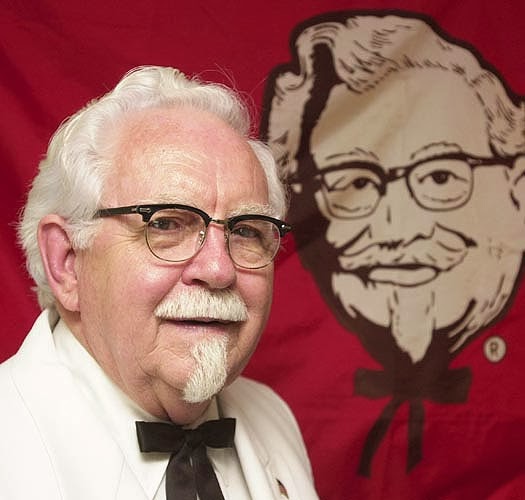
Story of Idea #1: Colonel Sanders' Fried Chicken Idea

All achievements, all earned riches, have their beginning in an idea
(Napoleon Hill)

To accomplish great things we must, not only dream but believe,
not only believe but act.” (Anonymous)

Let me cut the story short: Colonel Harland David Sanders (September 9, 1890 – December 16, 1980), who at the customary age of 65 received his first old age pension social security payment felt so dissatisfied that he decided to do something about it. Taking full responsibility for himself and with an idea in his mind he changed his life with the only asset he had – a family recipe for fried chicken.

At 65 he started to try and find restaurant owners who would pay him a share in their increased profits for their fried chicken sales that used his special recipe. 1,007 times he was told “No!” (Maybe if he were to come to me with this idea, I would probably say no too). The 1,008th said “Yes!” 9 years later he sold his business for USD2,000,000. That was a huge amount of money… the rest is history. Today his influence of idea is greatly known as Kentucky Fried Chicken (KFC).

He said, “I could have just complained about the system, cursed my luck and blamed everyone else, but I would have still been trying to live on that social security income, I had got me in that position. It was up to me to get me out.” If he never got the idea, take the action, persevere in the midst of 1,000 rejections, relentlessly achieving his dream – we will probably never taste his famous fried chicken. I will never his great idea. “One sound idea,” writes Napoleon Hill, “is all you need to achieve success.”

Lord, Give Us Today Our Daily Idea(s)

Top 10 Most Read Idea(s) Last 7 Days

Idea-Labels

Thinking Creative Question Action Change Your Life Essential Thinker Series Focus Positive Secrets of the Millionaire Mind Harv Eker Success Attitude Choice Learning Nurture Creativity Play Mindset Perspective Time Experience Habit Observation Curious Different Failure Hardworking How-to Generate Ideas Imagination Problem-Solving Wealth 12 Rules for Life Children Inspiration Jordan Peterson Relax Rich Break the Rules Change Perseverance Reading Risk-Taker Seeing Albert Einstein Barriers to Creativity Confidence I Wonder Series People The Subtle Art of Not Giving A F*ck (Mark Hanson) Connection Happiness Money Possibilities The 7 Habits of Highly Effective People Thought With Winning In Mind Asking Books Character Characteristics of Creative Person Is Technology Changing Our Brains Knowledge Practical Process Writing Believe Challenge Childlike Criticism How to Choose Optimism How to Nurture Your Child to Be Creative Innovative Listening Purpose Relationship Responsibility Story of Idea Thomas Edison Value 7 Climate Facts You Need to Know Communicate Control Enjoy Freedom Fun Idea-Quote Meaning Mistakes Open Mind Opportunity Optimistic Original Resourceful Roger von Oech Talent As A Man Thinketh Combination Commitment Discovery Don't Give Up Dream Energetic Environment Friendship Genius Give Up Growth Leonardo da Vinci Picture Playground Quiet Space Random Reason Start With Why (Simon Sinek) Steve Jobs Understand Walk Wisdom Yew Kam Keong Ability Ambiguity Behavior Crazy Daydreaming Decision-Making Example Facts about Creativity Faith Fear Feeling Goal Hearing Humour Improvement Independence Intuition Isaac Newton Lead Love Motivated Nature Non-Conformist Passion Potential Respect Savor Life Self-Image Stephen R. Covey The Power of Habit Word Alternative Application Awareness Common Blocks to Creativity Conversation Discipline Dynamic Emotion Encouragement Expectation Feedback Flexibility Idealistic Jack Foster Leader Logic Mindful Music Negative Performance Persistence Physical Reinforcement Result Right Answer Sixth Sense Society Talking The Human Body Tony Buzan Vincent Ryan Ruggiero Vision Adventurous Appreciate Attention Be Yourself Beautiful Christopher Columbus Conscious Daring Desire Edward de Bono Empathy Excuses Exercise Financial Galileo Goodness Hardship Help Henry Ford How to Be Innovative Humble IQ Jesus Kindness Laugh Let's Get Started! Memory Mental Rehearsal Michael J. Gelb Multitasking Nicolaus Copernicus Patient Pen and Paper Planning Power Praise Prejudice Proactive Progressive Quality Reality Recording Rejection Routine Sharing Simplicity Sleep Social Media Stand Firm Starbuck Stimulate Strength Stress Studying The Internet Theology Think like A Fool Touching Unpopular Usefulness Victor Hugo What If Win-Win Zig Ziglar 6 Common Creative Killers 9 Types of Intelligence A. Samad Said Affirmation Alexander the Great Aristotle Association Assumption Austin Kleon Balance Benedict de Spinoza Benjamin Franklin Bette Nesmith Graham Bill Gates Blessing Brainstorming Business Carpe Diem Chaos and Order Cicero Colonel Sanders Compliance Concentration Contribute Copernicus David Hume Descartes Desiderius Erasmus Development Diversity Don't Try Download Drug Elaboration Eleanor Roosevelt Enthusiasm Error Ethics Eurika Experiment Explore Extrovert Fluency Francis Bacon Free Book Generalist Giving Back Heroes Hopeful Hormones How to Spark Your Creative Mind How-to Maximizing a New Idea Howard Schultz Hunting Illustration Information Integrity Intention Interruption Introvert Investment James Webb Young Jason Mraz Jean-Jacques Rouseau Jim Carrey Jogging John Locke Jurgen Wolff Juxtapositions Legacy Leon Ann Mean Leon Trotsky Light Liquid Paper Machiavelli Management Manifestation Manipulation Marcus Aurelius Mark Zurkerberg Martin Luther Marty Neumeier Maturity Mental Mihaly Csikszentmihalyi Mind Maping Miracles Mission Statement Modeling Money Blueprint Mood Move On My Top 17 Book on Innovative and Creativity Lists Navigation Skills Niccolo Machiavelli Offline Ontology Ordinary Pablo Picasso Pain Paracelsus Paradigm Paradox of Creative People Parenting Passive Income Peace Perception Philosophy Plato Political Practice Priority Privacy Procrastination Productivity Promote Pythagoras of Samos Rational Rebellious Receiving Reformer Rene Descartes Resilience Resource Myopia Rest Reverse Robert Korn Running Safe Saving Say No Scientific Method Scott Belsky Self-Gratification Selling Seneca Skeptic Slow Down Smelling Social Skills Socrates of Athens Soichiro Honda Specialist Spider-Man St Anselm St Augustine of Hippo St Thomas Aquinas Steal like An Artist Stubborn Suffering Synergize Tasting Technology Thales of Miletus The Creative Environment The Empiricist The Mozart Effect Thomas More Tok Nan Toy Tradition Truth Uniformity Unique Universe Unorthodox Volunteer Walt Disney Wildlife Wonder Xenophanes of Colophon