Showing posts with label Dream. Show all posts

Thursday, November 12, 2015

Change Your Life: Be Hopeful and Optimistic

a movie
Tal Ben-Shahar in his book Choose the Life You Want writes that until 1954, running the mile under four minutes was considered a physical impossibility. Doctors and scientists all agreed that the four-minute mark represented the physiological limit of human ability. The best runners in the world confirmed the experts’ view by closing in on the four-minute mile but never bettering it. Runners spoke of the “brick wall,” an impenetrable barrier that existed at the four-minute mark.

Despite the prevailing conventional wisdom, Roger Bannister, a medical student at Oxford University, believed that he could run a mile in under four minutes. He was dismissed by other athletes and the scientific community as detached, unrealistic. On May 6, 1954, Roger Bannister broke the world record for the mile, running the distance in three minutes and fifty-nine seconds. The impossible had become reality! But there is more: only six weeks after Bannister’s achievement, John Landy, an Australian runner, ran the mile in three minutes and fifty-eight seconds. A year later, three runners broke the four-minute barrier in a single race. Since 1954, the four-minute mile has been surpassed thousands of times. The impenetrable barrier, it turned out, was a product of the mind – and it was broken by the mind.

The lesson to be learned from this story is that our beliefs – whether we are optimistic (I can!) or pessimistic (I can’t…) – play a significant role in creating our reality. This does not mean that we can throw reality out the window and that everything that we hope and wish for will come true, but it does imply that being hopeful and optimistic about life and believe in one selves can make it happen. George Bernard Shaw once says, “You see things; and you say, ‘Why?’ But I dream things that never were; and I say, ‘Why not?’” Where do your beliefs limit you? What barriers can you overcome on your way to fulfilling your dreams?

Don’t be a pessimist,
Be hopeful and optimistic.
Lord, Give Us Today Our Daily Idea(s)

Monday, September 28, 2015

Change Your Life: Just Do It!


“A thousand-mile journey begins with a first step”
(Lao-Tzu)

Procrastination – putting things off, dragging one’s feet, unnecessarily postponing what can and needs to be done today – is a pervasive phenomenon. Over 70 percent of college students, for example, identify themselves as procrastinators. The temptation to put things off is understandable, but the price we pay for procrastinating is high – studies show that procrastinators have higher levels of stress, a weaker immune system, poorer sleep, and unsurprisingly, given all of that, lower levels of happiness.

Fortunately, the research into procrastination has also identified practical ways that can help overcome the tendency to procrastinate. The single most important technique is called “the five-minute take-off.” It consists, simply, of starting to do the thing you have been putting off, no matter how little you feel like doing it. Procrastinators often believe that to do something one has to truly want to do it – to be in the right mood, to feel inspired. This is not the case. Usually, to get the job done, it is enough to begin doing it – the initial action kick-starts the process and often brings about more action.

So, for example, if you have difficulty getting yourself to exercise, just make the choice to put on your running shoes and start running: more often than not, the action will reinforce itself. If you have a project that needs to be done, don’t wait for that “right moment.” Choose to act, now! This approach can serve you well on a larger scale too: Commit to your vision, your dream, don’t procrastinate. Find ways to start moving forward the life you want to be living right now.

Don’t procrastinate,
Just do it!
Lord, Give Us Today Our Daily Idea(s)

 References:
1. Choose the Life You Want: 101 Ways to Create You Own Road to Happiness by Tal Ben-Shahar, PhD (New York: The Experiment, 2012) Buy this book!
2. Overcoming Procrastination: Or How to Think and Act Rationally in Spite of Life’s Inevitable Hassles by A. Ellis and W.J. Knaus (New York: Signet, 1979)

Tuesday, January 6, 2015

Nurture Creativity: Begin with the End in Mind and Take Actions


“[Begin with the end in mind] is based on imagination –
the ability to envision in your mind what you cannot at present see with your eyes”
(Steven R. Covey)

I love Dumb and Dumber To (2014) the movie – yesterday’s series, today’s movie. I love to watch Jim Carrey acting. I love Jim Carrey and I think he is one of the most creative people in the entertainment industry. Let me tell you his story before he become a megastar. Carrey spent a lot of his earlier time dwelling on his future. He believed he possessed the talent, but he wondered if his fifteen years of experience in the comedy clubs would make him go further. Until he did, he said, he could only practise, work hard, and maintain a positive attitude.

There was one time when he could not send money home or when his comedy appearances did not fare well, a depressed Carrey would lie awake at night questioning if he had done the right thing. In his book People in the News: Jim Carrey, John F. Wukovits quoted Carrey as saying: “You lay on your bed and the thing that you think about most is, ‘What is it about me that’s special and different? What’s my thing?’ I would struggle with that, trying to define myself.”

One time he wrote a fake cheque to himself in the amount of $10 million for ‘Acting services rendered’ post-dated it for Thanksgiving 1995, and placed it in his wallet as both an encouragement and a reminder that one day he would triumph. Carrey did not sign the cheque because he hoped to be wealthy, but “I wrote it as an affirmation of everything I learned. It wasn’t about money. I knew if I was making that much, I’d be working with the best people on the best material. That’s always been my dream. My parents taught me to believe in miracles. My life is proof that they exist.”

John F. Wukovits further wrote, “Jim Carrey often drove up Mulholland Drive and parked where he had a clear view of Los Angeles. Staring at the sprawling city below, Carrey promised that one day he would succeed in the entertainment business and that he would be the toast of the town.” Yes, no doubt, Carrey did it! See what he have become today. Creative people like Jim Carrey see the future with the end in mind. They dream dreams and they ask questions that will empower themselves to do whatever it take to achieve it. Creativity in itself it not enough. Awesome idea is not enough. Talent is not enough. Like Carrey, we must work hard, practise and maintain a positive attitude. In other word, creative people take actions. But first, creative people begin with the end in mind.

Begin with the end in mind and take actions, massive actions!
Lord, Give Us Today Our Daily Idea(s)

Tuesday, December 16, 2014

Be Creative: Let’s Get Started!

“Creativity with Food” by Hong Yi 
“One is not born a genius, one becomes a genius” (Simone de Beauvoir)

Creativity cannot be taught in the way that you can teach maths – nor by merely reading books or thru this blog articles – but it can be encouraged to grow and cultivate. If you decides to be creative, you’re conditioning yourself to be creative and welcoming good ideas into your mind. You don’t need to be a genius like Albert Einstein or cleaver like Edward de Bono or multi-gifted and talented like Leonardo da Vinci, all you need to do is to open yourself to the creative spirit that lies within you. Everybody have the capacity to be creative. So, be confidence and get started!

Here are some tips from Robert Allen, author of How to Be a Genius, on how-to fan your creative spark into a flame:

§  In future, all your ideas (however trivial they may seem) have to be collected and kept. You never know when an idea will come in handy, or when something that seemed unimportant when you first thought of it will suddenly become of vital importance.

§  Pick some creative projects to get yourself started. It helps to have several projects on the go at the same time, as they tend to cross-fertilize each other. It also helps if the projects are of quite different types.

§  Work on your project regularly and methodically. Don’t ever just sit around waiting for inspiration. If one project gets bogged down, turn to another and work on that. Make sure that you set yourself goals and deadlines – if you don’t do this, you may find that you run out of steam and fail to finish things you’ve started.

§  Try to keep your attitude as flexible as possible. Your subconscious mind has an agenda of its own and, in order for your efforts to succeed, you need to prepared to change your plans to accommodate whatever your subconscious prompts you to do.

§  Remember to have fun! Creativity is hard work but it is also enjoyable. Don’t get so focused on attaining your goal that you forget to enjoy the creative process.

§  Remember that having bright ideas, though very important, is only a part of the creative process. Once you have the idea you then have to work hard to bring it to fruition. This is the part of the process that defeats many would-be creative people. They enjoy the processes by which bright ideas are born but lack the energy to see their project through to the end. What a waste of good ideas! Make sure that you are a worker as well as a dreamer.

Be creative, let’s get started!
Lord, Give Us Today Our Daily Idea(s)

Thursday, February 13, 2014

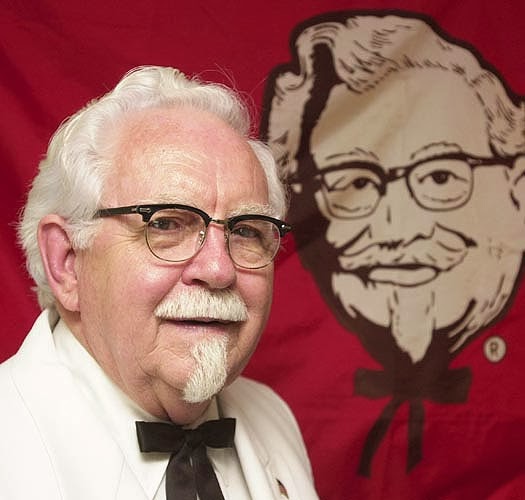
Story of Idea #1: Colonel Sanders' Fried Chicken Idea

“All achievements, all earned riches, have their beginning in an idea”
(Napoleon Hill)

“To accomplish great things we must, not only dream but believe,
not only believe but act.” (Anonymous)

Let me cut the story short: Colonel Harland David Sanders (September 9, 1890 – December 16, 1980), who at the customary age of 65 received his first old age pension social security payment felt so dissatisfied that he decided to do something about it. Taking full responsibility for himself and with an idea in his mind he changed his life with the only asset he had – a family recipe for fried chicken.

At 65 he started to try and find restaurant owners who would pay him a share in their increased profits for their fried chicken sales that used his special recipe. 1,007 times he was told “No!” (Maybe if he were to come to me with this idea, I would probably say no too). The 1,008th said “Yes!” 9 years later he sold his business for USD2,000,000. That was a huge amount of money… the rest is history. Today his influence of idea is greatly known as Kentucky Fried Chicken (KFC).

He said, “I could have just complained about the system, cursed my luck and blamed everyone else, but I would have still been trying to live on that social security income, I had got me in that position. It was up to me to get me out.” If he never got the idea, take the action, persevere in the midst of 1,000 rejections, relentlessly achieving his dream – we will probably never taste his famous fried chicken. I will never his great idea. “One sound idea,” writes Napoleon Hill, “is all you need to achieve success.”

Lord, Give Us Today Our Daily Idea(s)
Top 10 Most Read Idea(s) Last 7 Days

Idea-Labels

Thinking Creative Question Action Change Your Life Essential Thinker Series Focus Positive Secrets of the Millionaire Mind Harv Eker Success Attitude Choice Learning Nurture Creativity Play Mindset Perspective Time Experience Habit Observation Curious Different Failure Hardworking How-to Generate Ideas Imagination Problem-Solving Wealth 12 Rules for Life Children Inspiration Jordan Peterson Relax Rich Break the Rules Change Perseverance Reading Risk-Taker Seeing Albert Einstein Barriers to Creativity Confidence I Wonder Series People The Subtle Art of Not Giving A F*ck (Mark Hanson) Connection Happiness Money Possibilities The 7 Habits of Highly Effective People Thought With Winning In Mind Asking Books Character Characteristics of Creative Person Is Technology Changing Our Brains Knowledge Practical Process Writing Believe Challenge Childlike Criticism How to Choose Optimism How to Nurture Your Child to Be Creative Innovative Listening Purpose Relationship Responsibility Story of Idea Thomas Edison Value 7 Climate Facts You Need to Know Communicate Control Enjoy Freedom Fun Idea-Quote Meaning Mistakes Open Mind Opportunity Optimistic Original Resourceful Roger von Oech Talent As A Man Thinketh Combination Commitment Discovery Don't Give Up Dream Energetic Environment Friendship Genius Give Up Growth Leonardo da Vinci Picture Playground Quiet Space Random Reason Start With Why (Simon Sinek) Steve Jobs Understand Walk Wisdom Yew Kam Keong Ability Ambiguity Behavior Crazy Daydreaming Decision-Making Example Facts about Creativity Faith Fear Feeling Goal Hearing Humour Improvement Independence Intuition Isaac Newton Lead Love Motivated Nature Non-Conformist Passion Potential Respect Savor Life Self-Image Stephen R. Covey The Power of Habit Word Alternative Application Awareness Common Blocks to Creativity Conversation Discipline Dynamic Emotion Encouragement Expectation Feedback Flexibility Idealistic Jack Foster Leader Logic Mindful Music Negative Performance Persistence Physical Reinforcement Result Right Answer Sixth Sense Society Talking The Human Body Tony Buzan Vincent Ryan Ruggiero Vision Adventurous Appreciate Attention Be Yourself Beautiful Christopher Columbus Conscious Daring Desire Edward de Bono Empathy Excuses Exercise Financial Galileo Goodness Hardship Help Henry Ford How to Be Innovative Humble IQ Jesus Kindness Laugh Let's Get Started! Memory Mental Rehearsal Michael J. Gelb Multitasking Nicolaus Copernicus Patient Pen and Paper Planning Power Praise Prejudice Proactive Progressive Quality Reality Recording Rejection Routine Sharing Simplicity Sleep Social Media Stand Firm Starbuck Stimulate Strength Stress Studying The Internet Theology Think like A Fool Touching Unpopular Usefulness Victor Hugo What If Win-Win Zig Ziglar 6 Common Creative Killers 9 Types of Intelligence A. Samad Said Affirmation Alexander the Great Aristotle Association Assumption Austin Kleon Balance Benedict de Spinoza Benjamin Franklin Bette Nesmith Graham Bill Gates Blessing Brainstorming Business Carpe Diem Chaos and Order Cicero Colonel Sanders Compliance Concentration Contribute Copernicus David Hume Descartes Desiderius Erasmus Development Diversity Don't Try Download Drug Elaboration Eleanor Roosevelt Enthusiasm Error Ethics Eurika Experiment Explore Extrovert Fluency Francis Bacon Free Book Generalist Giving Back Heroes Hopeful Hormones How to Spark Your Creative Mind How-to Maximizing a New Idea Howard Schultz Hunting Illustration Information Integrity Intention Interruption Introvert Investment James Webb Young Jason Mraz Jean-Jacques Rouseau Jim Carrey Jogging John Locke Jurgen Wolff Juxtapositions Legacy Leon Ann Mean Leon Trotsky Light Liquid Paper Machiavelli Management Manifestation Manipulation Marcus Aurelius Mark Zurkerberg Martin Luther Marty Neumeier Maturity Mental Mihaly Csikszentmihalyi Mind Maping Miracles Mission Statement Modeling Money Blueprint Mood Move On My Top 17 Book on Innovative and Creativity Lists Navigation Skills Niccolo Machiavelli Offline Ontology Ordinary Pablo Picasso Pain Paracelsus Paradigm Paradox of Creative People Parenting Passive Income Peace Perception Philosophy Plato Political Practice Priority Privacy Procrastination Productivity Promote Pythagoras of Samos Rational Rebellious Receiving Reformer Rene Descartes Resilience Resource Myopia Rest Reverse Robert Korn Running Safe Saving Say No Scientific Method Scott Belsky Self-Gratification Selling Seneca Skeptic Slow Down Smelling Social Skills Socrates of Athens Soichiro Honda Specialist Spider-Man St Anselm St Augustine of Hippo St Thomas Aquinas Steal like An Artist Stubborn Suffering Synergize Tasting Technology Thales of Miletus The Creative Environment The Empiricist The Mozart Effect Thomas More Tok Nan Toy Tradition Truth Uniformity Unique Universe Unorthodox Volunteer Walt Disney Wildlife Wonder Xenophanes of Colophon