Showing posts with label Perseverance. Show all posts

Thursday, December 27, 2018

Secret of the Millionaire Mind: Wealth File #9 Rich People are Bigger than Their Problems


This is a chapter-by-chapter summary of a book by T. Harv Eker’s Secret of the Millionaire Mind: Mastering the Inner Game of Wealth (2005) series. One chapter, one article. Read this summary, buy the book. Enjoy!

Wealth File #9:
Rich People are Bigger than Their Problems.
Poor People* are Smaller than Their Problems.

The size of the problem is never the issue, what matters is the size of you! Harv Eker said, “If you have a big problem in your life, all that means is that you are being a small person!” Either you are whining about the problem or you are working on the solution. This is straight to the point: It’s all about you! Whatever happens in your life, be it good or bad, interesting or boring, tough or easy, what matters is how you get affected by it. What matters is you! There are no problems, there are only situations. We then make them a problem. Respectively, some people make it a problem, others don’t even get affected or realize it. How can that be?

Good question, right? How can it be that the exact same situation is a problem for one but not for another? It depends on the person, you may say – and you’re right. It depends on you. I remember when I went to work from KL Central to Times Square. Monorail KL would take people every five minutes or so. At times, these trains were crazily crowded (especially on weekends). You see in the faces of people how they felt about the situation. And interestingly, some people got negatively affected by the crowded train EVERY SINGLE DAY. Why? Are you that small of a person that a crowded train is a problem for you? And even if it is (e.g. due to claustrophobia, fear of being in closed/crowded places), you do have other options such as go earlier, go by bus or bike, use a taxi or Grab, or walk…

Do you see my point? You can either whine about the situation (make it a problem) or work on the solution. Eker says it over and over again, “What matters is the size of you.” The more you work on yourself, the fewer the problems there will be – you’ll be bigger than any problem. So, don’t be the person whining about the crowded train… that’s NOT a problem! “It’s not what happens to you,” said the wise Epictetus, “but how you react to it that matters.” Say this to yourself…

[*I need to note that the Harv Eker makes it clear in this book that he does not mean to degrade poor people. He does not think that rich people are better than poor or middle-class people. They’re just richer.]

I Have A Millionaire Mind!

Wednesday, February 14, 2018

The Subtle Art of Not Giving A F*ck: The Important of Saying NO (Chapter 8 Summary)


This is a chapter-by-chapter summary of a book by Mark Manson’s The Subtle Art of Not Giving A F*ck: A Counterintuitive Approach to Living a Good Life (2016) series. One chapter, one article. Read this summary, buy the book. Enjoy!

Ultimately the only way to achieve meaning and a sense of importance in one’s life is through a rejection of alternative, a narrowing of freedom, a choice of commitment to one place, one belief or (gulp) one person
(Mark Manson)

By attempting to “have it all” you can easily end up having nothing. This is what Manson discovered after years of travelling the world, thinking he was living the high life. He would float from city to city, and from bed to bed, never staying long enough to commit to friends or lovers. But what he thought at first was freedom turned out to mean nothing. Eventually, Manson returned to the United States, settled down in one city and married to one woman. Giving up the idea of freedom he had held while travelling allowed him to develop a family and community that gave his life more meaning than ever before.

This is not to say that travelling is not valuable, or that everyone ought to commit to family life. Rather, it means that at some point you have to choose what is important to you and discard what is not important. Manson realized that family and community was important, and therefore he had to say no to travel around the globe. Rejecting certain choices defined Manson – he created a new identity for himself based on what he discarded.

F#ck! Learn how and when to say – NO.

Friday, August 7, 2015

Self-Esteem and Creativity: An Example of Walt Disney


In my opinion, most creative-successful people in life are those who retain a strong belief in their own worth and value, even when they have few material possessions to sustain them. They hold fast to their dreams and believe in the validity of their ideas, their belief being stronger than the rejection or acceptance of them by other people. 

When Walt Disney had a new idea he would ask ten people at random what they thought about it. If they all gave negative responses, he would start working on his idea immediately. Walt Disney had many rejections to deal with during his lifetime as a result of seeing things differently from other people and putting everything he had into his dreams. When Walt Disney was trying to find people in Hollywood to give him financial backing for an early cartoon, Mickey Mouse in Steamboat Willie, he was bankrupt. It is hard to imagine just how difficult it must have been in the days of silent films to sell anyone the idea of a talking mouse with a funny voice. However, children and adults around the world today continue to appreciate the wonderful films and magical theme-parks created by this remarkable dreamer.

So was Walt Disney a better human being when he was bankrupt and still doing the original voice of Mickey Mouse, or after he had made all those marvelous films and created those magical theme-parks? Walt Disney had the kind of self-esteem that enable him to persevere long after others would have stopped trying. He had a self-sustaining confidence in his own abilities and dreams, and clearly understood that real value resides in the doer and not in the deed.


Lord, Give Us Today Our Daily Idea(s)

Monday, January 19, 2015

Nurture Creativity: Have Crazy Idea, Don't Give Up!

Fred Smith, founder of FedEx
I think there are two keys to being creatively productive.
One is not being daunted by one’s fear of failure, the second is sheer perseverance
(Mary-Claire King)

It’s so crazy, it might just work,” said Fred Smith optimistically. He was an undergraduate at Yale University in 1965. As part of the coursework, he wrote an economics paper exploring the process of transportation of goods in the United States. Fred Smith wrote “crazy” idea on paper how a company carrying small, essential items by plane could be a much better business. He, however, did not go into details about how to actually run such a company.

As expected, his professor gave the paper a grade of “C”. Just like Smith’s professor, other people thought that the idea was indeed deserving a “C”. Some even thought that it was “crazy”. It was, but not for Fred Smith. Therefore, Smith held on to the crazy idea despite what others thought of it. He believes in his idea. To cut the story short, in 1971, the company was launched. It is called FedEx Express. Throughout the years, will all the challenges and failures, Smith never give up. “Today,” wrote Abhash Kumar, in YouStory.com, “FedEx is a global giant with operations in more than 220 countries and territories and an annual revenue of US $45 billion.”

What I learned from Fred Smith’s story is this: Logic will dictate that we stay away from crazy ideas. True, but the crazy ones are dared to go beyond what is “logical” and what is “safe”. They were the ones who have ventured out of the boundaries of the norm. Highly creative people are basically crazy. And once they believe in the idea, they will never give up. Remember Steve Jobs’ famously quote: “the ones who are crazy enough to think that they can change the world, are the ones who do.” Are you crazy enough? Do you have “crazy” idea that you believe in despite people’s negative criticisms about it? Do you want to change the world? Then, stay on. Don’t give up.

Many ideas deemed as crazy at first may just turn out to be very creative and innovative. “Nearly all creative ideas can sound crazy when first presented,” write Nolan Bushnell, founder of Atari. He continues, “Most people don’t have creative imaginations, so most people don’t get what the creative is saying. And people tend to be fearful of things they don’t understand.” Here is the fact: Not all crazy ideas have worked out – but most do. Add that crazy idea to perseverance and believe. Remember, some will just laugh at your idea. Don’t give up. If it is a worthy idea, make it work despite how silly it may sounds.

Have crazy idea. Don’t give up.
God, Give Us Today Our Daily Idea(s)

Tuesday, January 6, 2015

Nurture Creativity: Purpose Stimulate Breakthrough Idea


A noble purpose inspires sacrifice, stimulates innovation and encourages perseverance
(Gary Hamel)

I’m fascinated by the life of Thomas Edison. Anybody who can give the world the electric light, the microphone, the storage battery, the phonograph and a thousand other inventions, is worth studying. Historians say he was driven by one word: PURPOSE. Not pleasure, not popularity, not even personal gain, but – PURPOSE. Purpose stimulates breakthrough idea.

Here are some of the recorded principles by which he lived:
1)    Work to obtain all the knowledge you can about what you want to achieve,
2)    Fix your mind on your purpose. Persist! Seek! Use all knowledge you can accumulate or learn from others,
3)    Keep on searching no matter how many times you meet with disappointment,
4)    Refuse to be influenced by the fact that someone else tried the same thing and failed,
5)    Keep yourself sold on the idea that a solution to the problem exists somewhere, and that you’ll find it.

Then he added: “The trouble with most people is, they quit before they ever start.” Anyone can come out with idea, brilliant idea, but without purpose the motivation even to start will not make idea into a reality. Quitting is idea-destructor. Purpose, “fix your mind on your purpose” is a great idea-stimulator. Because of the vision and purpose that God puts in Nehemiah’s heart, he can rebuild the city wall. Nehemiah (of the Bible) didn’t conquer through brilliance (remember, most creative people in the history are school dropouts), he conquered through persistence, perseverance – and yes, prayer. He never quit. He have a purpose. In spite of the criticism, in spite of the pressure, he refuse to give up – that’s why he rebuilt Jerusalem. Purpose stimulate breakthrough idea.

What inspires you? What could you do to make this world a better place? Could you improve your local community in some way that contributes to the greater wellbeing and safety of its residents? Could you invent something or come out with ideas that will improve people lives and create awareness in your campus, church or community? Can you come up with a creative breakthrough that will challenge your potential and develop your personal skills? Will you use your God given mind and knowledge to come up with a way to raise funds for your favourite charities and causes?

What is your purpose?
Purpose stimulate breakthrough idea
Lord, Give Us Today Our Daily Idea(s)

Monday, December 15, 2014

Common Blocks to Creativity #1: Fear of Failure


Many of life's failures are people who did not realize
how close they were to success when they gave up.” (Thomas A. Edison)

From our childhood, success is usually rewarded and failure is punished, so some of us develop an exaggerated fear of failure. Such individuals are likely to avoid competitive situations, situations in which they are likely to be compared to others. A strong fear of failure makes us avoid risks. At times, it makes us take excessive risks to have an alibi for failure.

Although some fear of failure is useful in mobilizing us for a task, excessive fear of failure prevents us from acting at our best. The fear of failure mind-set often say to themselves: “It’s never work”; “We don’t have the time”; “It’s not in the budget”; “The Boss will never go for it”; “We’re always done it this way”; “That sounds stupid”; “Let’s see what the committee thinks”; “It’s not our style”; “I’ve seen that before somewhere”; “The last person who suggested that doesn’t work here anymore”; etc. These killer-thought-phrases destroys ideas before they have the chance to prove themselves. Fear of failure avoid risks and thus expelled many new unproven ideas. What a lost!

The acceptance of failure as necessary part of life is the best way to get rid of this block. No child would learn to work if it was excessively afraid of falling. Failure is a necessary as success in learning new skills. Failure simply means that we have to try harder, or that we have to take a new approach. It does not mean we are no good but that we have found new ways not to fail again. “I have not failed,” said Thomas A. Edison, “I've just found 10,000 ways that won't work.” This way failure can be a tremendous source of information and a powerful spur to growth and improvement. Do not fear. If you fail, try again!

Lord, Give Us Today Our Daily Idea(s)

References:
1.      Lifelong Creativity: An Unending Quest by Pradip N. Khandwalla (Tata McGraw-Hill Publishing Company Limited, 2004).

2.      Breakthrough Thinking: Using Creativity to Solve Problems by Nick Souter (ILEX, 2007)

Monday, October 13, 2014

Creativity is an Attitude!

            
Creativity is more than knowledge and is also more than an ability. It is an attitude. People are born with creative ability and most people possess adequate knowledge but because they think they are not creative and hence true to the rule of self-fulfilling prophesy, they become not creative. The second obstacle is society’s attitude. Society tends to ridicule those who are different – not only those who behave differently but those who think differently. Different is assumed to be abnormal.
Creative people do not toe the line. They are independent thinkers. They are not worried to what others think. History is full of ‘eccentric’ thinkers and inventors who not only think differently (and hence discover new theories) but they behave differently too, as seen in their dressing and demeanour (perangai, tabiat, kelakuan, tingkah laku), for instant. Can you picture Albert Einstein with his trademark shaggy hair? Or A. Samad Said without his shaggy beard and moustache?

Creativity is more than knowledge. It is an attitude. Many people possess the knowledge, but they dare not translate it into action in the form of inventions or innovations due to the variety of factors, one of which is the fear of failure. Failure to attempt, people say, is worse that actually failing. We learn after a failure. We learn nothing if we did not even attempt it. People, in general, also fear being laughed at. They have an idea but they dare not articulate it in case people laugh at them (People laughed at my ideas so often that I tend to take it as pre-congratulations).

Creative people are risk-takers; to them, failure is taken as a learning experience. Their first article writing maybe a disaster but they will push on, knowing that mistake or failure is the first step towards success. Creative people are also very persevering. They will keep on trying until they succeed. Creative people are independent, humorous and may appear eccentric but they are all there. Many well-known creative people are a little different. They know that they are creative. These creative people are much better off than those who think that they are not creative when they actually are, who incidentally form the majority. Do not be part of the majority. Be the minority who knows they are creative.

Creativity require knowledge, no doubt. It is an ability.
But most important of all, creativity is an attitude!
Think creative and we will be creative. This I know.
Lord, Give Us Today Our Daily Idea(s) 

Sunday, October 12, 2014

Characteristics of Creative Person

Conan O’Brien expresses himself for Fast Company’s Most Creative People issue (June 2011). 
This is funny!
Creative people are idealistic, energetic, confident, independent, thorough, adventurous, child-like, possesses a sense of humour, are perseverance and spontaneous and are risk-takers. Do you possess any one (or more) of these characteristic? If you do, then you are a creative person.

Creative people are independent thinkers. They can work by themselves and are not afraid of what people may say. They transcend accepted patterns of thinking. They do not conform to rules and regulations that restrict their freedom to think and act. They do not follow the crowd. People who are creative are full of energy. They possess a certain characteristic zest and a habit for spontaneous action. Creativity requires energy. Energetic people have the power and stamina to create new ideas, new things and new journeys.

Creative people are more likely to engage in adventurous and stimulating acts such as kayaking, mountain climbing, going places in rural areas or working overseas. They trod the unbeaten path. They have a strong curiosity and urge to understand the world around them and to try almost everything. Hence their wide interests and unusual hobbies. A sense of self-confidence is central to creativity. One cannot create if one is not confident of one’s abilities and capabilities. Self-confidence is not only inborn but it may also be developed through experience and exercise.

People who are creative are also playful and child-like. They have no prejudices and are not tainted by adult notions of what is proper and not proper. They are still full of wonder and are not afraid of criticism and comment. They are not bound by convention. Creative people are non-conformists to some extent. A sense of humour is another attribute of creative people. Humour may lead to great discoveries, invention and artistic creation. A fanciful, playful and excitable state of mind is an important feature of creative thinking and creative thinkers. Developing the ability to see the humorous side of life is a prerequisite to creativity.

A strong sense of perseverance, persistence and unwillingness to give up is another characteristic of creative people. They do not give up so easily or so readily. They will try again and again. Each failure is viewed as a learning experience. Creative people also risk-takers. Risk is everywhere. We take risk while driving to work, while playing games and when giving an opinion. If we do not try out new ideas and take risk, how do we know it will work or not? The greatest failure is not to attempt a new idea at all. The world’s greatest inventors, discoverers and pioneers are all risk-takers. Because they have independent mind and high-confidence in themselves, they are more willing to take creative risk than the average person. They dare to differ, to make changes and to deviate from the usual.

Are the characteristics enumerated above innate or are they acquired? The answer is – both. We are born with creative characteristics and we can learn to be creative too. Creative abilities exist in varying degrees in everyone of us. It is a matter of getting these abilities to surface and make them work for you. Creativity is within every one of us. It not the exclusive possession of a select few*.
Lord, Give Us Today Our Daily Idea(s)

*These characteristic are taken from Leo Ann Mean’s On Creativity: Awaken the Creative Mind (Chapter 2: Creative Person). Use and modified without permission. That’s what creative people do.

Wednesday, October 8, 2014

Barriers of Creativity #4: "Be Practical"


Creativity, like common sense, is supposed to be common. Creativity is natural and spontaneous. Yet it is not exhibited as frequently as it should. Experts believe that there are several reasons for this. These reasons are called ‘Barriers to Creativity’. ‘Barriers’ are the thing that stop us from thinking creatively and the reason that make us not as creative as we should be.

Barrier #4: “Be Practical”
            Remember when you suggest something and someone says it’s impractical? Kills your enthusiasm doesn’t it? Unlike any other God’s creations, human beings possess imagination. Our thinking is not limited to the real and present. We can imagine – and imagination is the first step in creative thinking.
            But the problem here is too many people always think of the practicality of things. “Your ideas”, they say, “must be practical.” And practical is what they know until then. We haven’t even tried the idea yet to see whether it works and it is already shot down. Frustrating. But creative people are perseverance and stubborn. They do not give up easily. For them, there is a place for practicality and there is a place for possibility. Remember Mr. Thomas E. Edison? He failed almost a thousand times before he finally invented the incandescent light bulb that evolves into the many type of lights that we’re using now.    

Cultivate your imagination.

Lord, Give Us Today Our Daily Idea(s)

Barriers of Creativity #3: "Follow the Rules"


Creativity, like common sense, is supposed to be common. Creativity is natural and spontaneous. Yet it is not exhibited as frequently as it should. Experts believe that there are several reasons for this. These reasons are called ‘Barriers to Creativity’. ‘Barriers’ are the thing that stop us from thinking creatively and the reason that make us not as creative as we should be.

Barrier #3: “Follow the Rules”
            There is a lot of pressure in our culture to follow the rules. ‘Do not try to be different’; ‘Do what everybody else does’; ‘Uniformity and compliance to rules make society work’; ‘Let’s do things the way they have always been done’; ‘It makes sense’; ‘Do not rock the boat’ etc.
            For creative thinking there is no virtue in doing things the way they have always been done. Creativity means doing things in new and better ways. If we keep doing things the same way we will never improve. Following the rules is a mental block, for we will always think of things as they are not as it can be. Tradition kills creativity. Challenging the rules (there is a limit however. As a Christian, I will not intentionally challenge God's Commandments) is a good creative thinking strategy. Ask these questions: Is this the only way? Is this the best way? Are there better ways?

Challenge the rules.

Lord, Give Us Today Our Daily Idea(s)

Thursday, February 13, 2014

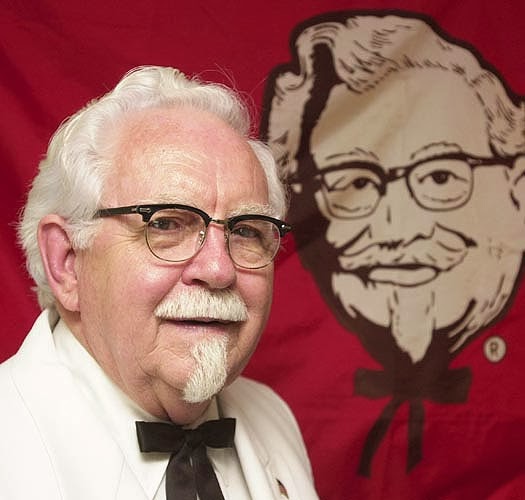
Story of Idea #1: Colonel Sanders' Fried Chicken Idea

All achievements, all earned riches, have their beginning in an idea
(Napoleon Hill)

To accomplish great things we must, not only dream but believe,
not only believe but act.” (Anonymous)

Let me cut the story short: Colonel Harland David Sanders (September 9, 1890 – December 16, 1980), who at the customary age of 65 received his first old age pension social security payment felt so dissatisfied that he decided to do something about it. Taking full responsibility for himself and with an idea in his mind he changed his life with the only asset he had – a family recipe for fried chicken.

At 65 he started to try and find restaurant owners who would pay him a share in their increased profits for their fried chicken sales that used his special recipe. 1,007 times he was told “No!” (Maybe if he were to come to me with this idea, I would probably say no too). The 1,008th said “Yes!” 9 years later he sold his business for USD2,000,000. That was a huge amount of money… the rest is history. Today his influence of idea is greatly known as Kentucky Fried Chicken (KFC).

He said, “I could have just complained about the system, cursed my luck and blamed everyone else, but I would have still been trying to live on that social security income, I had got me in that position. It was up to me to get me out.” If he never got the idea, take the action, persevere in the midst of 1,000 rejections, relentlessly achieving his dream – we will probably never taste his famous fried chicken. I will never his great idea. “One sound idea,” writes Napoleon Hill, “is all you need to achieve success.”

Lord, Give Us Today Our Daily Idea(s)

Top 10 Most Read Idea(s) Last 7 Days

Idea-Labels

Thinking Creative Question Action Change Your Life Essential Thinker Series Focus Positive Secrets of the Millionaire Mind Harv Eker Success Attitude Choice Learning Nurture Creativity Play Mindset Perspective Time Experience Habit Observation Curious Different Failure Hardworking How-to Generate Ideas Imagination Problem-Solving Wealth 12 Rules for Life Children Inspiration Jordan Peterson Relax Rich Break the Rules Change Perseverance Reading Risk-Taker Seeing Albert Einstein Barriers to Creativity Confidence I Wonder Series People The Subtle Art of Not Giving A F*ck (Mark Hanson) Connection Happiness Money Possibilities The 7 Habits of Highly Effective People Thought With Winning In Mind Asking Books Character Characteristics of Creative Person Is Technology Changing Our Brains Knowledge Practical Process Writing Believe Challenge Childlike Criticism How to Choose Optimism How to Nurture Your Child to Be Creative Innovative Listening Purpose Relationship Responsibility Story of Idea Thomas Edison Value 7 Climate Facts You Need to Know Communicate Control Enjoy Freedom Fun Idea-Quote Meaning Mistakes Open Mind Opportunity Optimistic Original Resourceful Roger von Oech Talent As A Man Thinketh Combination Commitment Discovery Don't Give Up Dream Energetic Environment Friendship Genius Give Up Growth Leonardo da Vinci Picture Playground Quiet Space Random Reason Start With Why (Simon Sinek) Steve Jobs Understand Walk Wisdom Yew Kam Keong Ability Ambiguity Behavior Crazy Daydreaming Decision-Making Example Facts about Creativity Faith Fear Feeling Goal Hearing Humour Improvement Independence Intuition Isaac Newton Lead Love Motivated Nature Non-Conformist Passion Potential Respect Savor Life Self-Image Stephen R. Covey The Power of Habit Word Alternative Application Awareness Common Blocks to Creativity Conversation Discipline Dynamic Emotion Encouragement Expectation Feedback Flexibility Idealistic Jack Foster Leader Logic Mindful Music Negative Performance Persistence Physical Reinforcement Result Right Answer Sixth Sense Society Talking The Human Body Tony Buzan Vincent Ryan Ruggiero Vision Adventurous Appreciate Attention Be Yourself Beautiful Christopher Columbus Conscious Daring Desire Edward de Bono Empathy Excuses Exercise Financial Galileo Goodness Hardship Help Henry Ford How to Be Innovative Humble IQ Jesus Kindness Laugh Let's Get Started! Memory Mental Rehearsal Michael J. Gelb Multitasking Nicolaus Copernicus Patient Pen and Paper Planning Power Praise Prejudice Proactive Progressive Quality Reality Recording Rejection Routine Sharing Simplicity Sleep Social Media Stand Firm Starbuck Stimulate Strength Stress Studying The Internet Theology Think like A Fool Touching Unpopular Usefulness Victor Hugo What If Win-Win Zig Ziglar 6 Common Creative Killers 9 Types of Intelligence A. Samad Said Affirmation Alexander the Great Aristotle Association Assumption Austin Kleon Balance Benedict de Spinoza Benjamin Franklin Bette Nesmith Graham Bill Gates Blessing Brainstorming Business Carpe Diem Chaos and Order Cicero Colonel Sanders Compliance Concentration Contribute Copernicus David Hume Descartes Desiderius Erasmus Development Diversity Don't Try Download Drug Elaboration Eleanor Roosevelt Enthusiasm Error Ethics Eurika Experiment Explore Extrovert Fluency Francis Bacon Free Book Generalist Giving Back Heroes Hopeful Hormones How to Spark Your Creative Mind How-to Maximizing a New Idea Howard Schultz Hunting Illustration Information Integrity Intention Interruption Introvert Investment James Webb Young Jason Mraz Jean-Jacques Rouseau Jim Carrey Jogging John Locke Jurgen Wolff Juxtapositions Legacy Leon Ann Mean Leon Trotsky Light Liquid Paper Machiavelli Management Manifestation Manipulation Marcus Aurelius Mark Zurkerberg Martin Luther Marty Neumeier Maturity Mental Mihaly Csikszentmihalyi Mind Maping Miracles Mission Statement Modeling Money Blueprint Mood Move On My Top 17 Book on Innovative and Creativity Lists Navigation Skills Niccolo Machiavelli Offline Ontology Ordinary Pablo Picasso Pain Paracelsus Paradigm Paradox of Creative People Parenting Passive Income Peace Perception Philosophy Plato Political Practice Priority Privacy Procrastination Productivity Promote Pythagoras of Samos Rational Rebellious Receiving Reformer Rene Descartes Resilience Resource Myopia Rest Reverse Robert Korn Running Safe Saving Say No Scientific Method Scott Belsky Self-Gratification Selling Seneca Skeptic Slow Down Smelling Social Skills Socrates of Athens Soichiro Honda Specialist Spider-Man St Anselm St Augustine of Hippo St Thomas Aquinas Steal like An Artist Stubborn Suffering Synergize Tasting Technology Thales of Miletus The Creative Environment The Empiricist The Mozart Effect Thomas More Tok Nan Toy Tradition Truth Uniformity Unique Universe Unorthodox Volunteer Walt Disney Wildlife Wonder Xenophanes of Colophon