Showing posts with label Success. Show all posts

Monday, January 28, 2019

Secret of the Millionaire Mind: Wealth File #17 Rich People Constantly Learn and Grow


This is a chapter-by-chapter summary of a book by T. Harv Eker’s Secret of the Millionaire Mind: Mastering the Inner Game of Wealth (2005) series. One chapter, one article. Read this summary, buy the book. Enjoy!

Wealth File #17:
Rich People Constantly Learn and Grow.
Poor People* Think They Already Know.

Becoming rich isn’t as much about getting rich financially as about whom you have to become, in character and mind, to get rich. “The goal of creating wealth is to help you grow yourself into the best person you can possibly be,” writes Harv Eker. An adage says, “You take yourself with wherever you go.” If you grow yourself to become a successful person, in the strength of character and mind, you will naturally be [almost] successful in anything and everything you do. You will gain the power of choice. You will gain the inner power and ability to choose any job, business, or investment arena and know you’ll be a success. This is the essence of this book. This, I think, is MASSIVE.

Getting rich is about who you have to become as a person to get rich.” Who do you need to be to get rich? That’s a powerful question. When you sincerely answer it, you’ll know to get rich is about you, and nothing else. “The fastest way to get rich and stay rich is,” revealed Eker, “to work on developing you!” You need to grow. What does that mean? Grow in height? Not so much. Grow your hair? Nope (I’m offended!). Grow in character? Yes. Grow as a person? Yes, that’s it! It’s about continuous improvement of self. To try every day to become the best version of ourselves. In short: If you are not growing, you are dying. Jim Rohn once said, “If you keep doing what you’ve always done, you’ll keep getting what you’ve always got.” So start growing!

One way to get started is to realize that: WE CAN CHANGE. It has never been easy, I know, but we must change… or die. If you want to be successful, you have to copy the successful people. Start with that. If you want to have a great body, you have to copy models or bodybuilders. If you want to be a great salesperson, you have to copy great salesperson. If you want to be rich, then, you have to copy rich people. This is all learnable. “Rich people take advice [or follow examples] from people who are richer than they are,” compares Eker, “Poor people take advice from their friends, who are just broke as they are.” You just need to change something in your lives. You need to take the actions [refer to Wealth File #16] that are necessary to become who you want to become. You need to constantly learn and grow. “The more you learn, the more you earn.” So true!

I Have A Millionaire Mind!

[*I need to note that the Harv Eker makes it clear in this book that he does not mean to degrade poor people. He does not think that rich people are better than poor or middle-class people. They’re just richer.]

Saturday, December 22, 2018

Secret of the Millionaire Mind: Wealth File #7 Rich People Associate with Positive, Successful People


This is a chapter-by-chapter summary of a book by T. Harv Eker’s Secret of the Millionaire Mind: Mastering the Inner Game of Wealth (2005) series. One chapter, one article. Read this summary, buy the book. Enjoy!

Wealth File #7:
Rich People Associate with Positive, Successful People.
Poor People Associate with Negative or Unsuccessful People.

Why reinvent the wheel? “The fastest and easiest way to create wealth,” said Eker, “is to learn exactly how rich people, who are the masters of money, play the game.” If you want to fly with eagles, don’t swim with the ducks! Why reinvent the wheel? The logic is simple: If your goal is to be rich, then study the rich people. Do what they do. There is a reason why they are rich. The easiest way of studying them is being near to them. It’s simple. It’s similar to entering the corridor (refer to the previous post) to get to know the business. From the inside, you learn much, much more in much, much less time. Again, if you want to be rich, model rich people. If you want to be a great leader, for another example, then model great leaders! This is logic: If you take the exact same actions and have the exact same mindset, chances are good you will get the exact same results.

Another way to say this wealth file is associated with people who have achieved what you want to achieve. They know a lot. They know how to act and what to do. They have the skills needed to succeed. Associate with them, study them. Let’s take an example from the animal kingdom if a chicken just swims with the ducks, how is it going to learn how to fly like an eagle? Guess what, it’s not… and the same holds true for you. If you hang out with poor people* only, you’re never going to be rich (By hangout with the rich, this can also mean ‘hangout’ with their books, videos, and podcasts). Talking of birds, you’ve probably heard the saying, “Birds of a feather flock together.” This saying basically says that people of the same kind often hang out together. People spend time with people who are similar or they become the people they hang out always. What’s first come to your mind: Do you flock together because you are similar or do you become similar because you flock together?

Jim Rohn once said, “You are the average of the five people you spend the most time.” Have you read this quote? Yes? Good. No? Read it. Jim Rohn just gave the answer to my question. What matters is who you spend MOST time with (of course you may hang out with anyone you like, no discrimination). If the people you hang out with are positive, chances are high you’re positive too. If they’re complaining, chances are high that you complain too. “Rich people hang around with winners. Poor people* hang around with losers. Why? It’s a matter of comfort,” said Eker, somewhat hard-truth, “Rich people are comfortable with other successful people. They feel worthy of being with them. Poor people are unfordable with highly successful people. They’re either afraid they’ll be rejected or feel as if they don’t belong. To protect itself, the ego then goes into judgment and criticism.” Either you agree or disagree with Eker’s statement, this principle remains solid: If you want to get rich, model and associated with rich people. If you don’t have rich friends (like me, not yet so far), read their books – the books that they wrote or the books that they read or both. Or watch their videos on YouTube or listen to their talks and interviews on podcasts. Do it!

[*I need to note that the Harv Eker makes it clear in this book that he does not mean to degrade poor people. He does not think that rich people are better than poor or middle-class people. They’re just richer.]


I Have A Millionaire Mind!

Monday, December 17, 2018

Secrets of the Millionaire Mind: Wealth File #6 Rich People Admire Other Rich and Successful People (Summary)


This is a chapter-by-chapter summary of a book by T. Harv Eker’s Secret of the Millionaire Mind: Mastering the Inner Game of Wealth (2005) series. One chapter, one article. Read this summary, buy the book. Enjoy!

Wealth File #6:
Rich People Admire other Rich and Successful People.
Poor People Resent Rich and Successful People.

Poor people* often look at other people’s success with resentment, jealousy, and envy. “You have to realize that if you view rich people as bad in any way, shape, or form, and you want to be a good person, then you can never be rich,” writes Eker, “It’s impossible. How can you be something you despise?” That’s an easy psychological truth: You become rather like someone you admire than like someone you resent. Keep that in mind. From now on, when you see something you (secretly) want, may it be a nice house or a dream car or someone who is wise, admire what you see. Admire the house and also admire the owner. Admire the car and also the brain. Don’t be jealous, don’t be envy, admire them. Bless them. Love them. Practice the Huna philosophy: “Bless that which you want.”

Why do people resent rich people? Why do people think that poor people are in some way better spiritually than the rich? To put it bluntly – that’s just stupid! There is absolutely no reason to think worse about the rich than about the poor. Of course, there are some rich people who don’t act morally and ethically right, but that same holds true for some poor people. No doubt there are always exceptions to any rule, but for the most part, who do you have to be to succeed at anything? Try some of these characteristics: positive, reliable, focused, determined, persistent, hardworking, energetic, good with people, a competent communicator, intelligent, an expert in at least one area, etc. What does it take to get rich and successful? How can someone become successful? Some or all of the above? Does negativity, laziness and being average at everything make you a success?

The answer to the last question is crystal clear – NO! If you want to become successful, you need powerful traits that make you who you are. Rich people are rich because they have the character it needs to get rich. Being rich is nothing to do with being lucky, acting mean or morally wrong, being a bully, using people or whatsoever. So why would you resent someone who actually worked a lot for his or her success? Who was persistent? Who always tried to be his best? Who is reliable and focused? Why would you resent someone when you’d secretly want to be like that person?

To put it clearly, when you resent the success of others, you’re not going to get any… When you resent your friend for having a girlfriend, you’re not going to get one. When you resent someone for having a Mercedes, you’re not going to have one. When you resent a rich person for his or her money, you’re NOT going to get ANY MONEY. “Act like rich people and admire what you want. Bless what you want. Love what you want,” Eker emphasized. Yes, love what you want, love what you want, LOVE WHAT YOU WANT!

[*I need to note that the Harv Eker makes it clear in this book that he does not mean to degrade poor people. He does not think that rich people are better than poor or middle-class people. They’re just richer.]

I Have A Millionaire Mind!


Tuesday, November 27, 2018

Secrets of the Millionaire Mind: Wealth File #2 Rich People Play the Money Game to Win, Poor People Play to Not Lose (Summary)

This is a chapter-by-chapter summary of a book by T. Harv Eker’s Secret of the Millionaire Mind: Mastering the Inner Game of Wealth (2005) series. One chapter, one article. Read this summary, buy the book. Enjoy!

Wealth File #2:
Rich People play the Money Game to Win.
Poor People play the Money Game to Not Lose.

Poor people’s* primary concerns are “survival and security” instead of creating wealth and abundance said Eker. The goal of truly rich people is to have massive wealth and abundance. Not just some money, but lots of money. “If your goal is to be comfortable, chances are you’ll never get rich,” Eker reasoned, “But if your goal is to be rich, chances are you’ll end up mighty comfortable.” He reminds us of the power of intention. When your intention is to have enough to pay the bills, that’s exactly how much you’ll get – just enough to pay the bills and not a dime more.

Think about this: If your goal is to have just enough money to pay the bills, how much money do you think you’ll get? Exactly! Just enough to pay the bills… You get what you truly intend to get. And that’s what so many people strive for: “I just want enough to pay the bills.” “I just want to live a moderate life and go on vacation once a year” (maybe this is my dream: to live moderately but slightly rich, and go on vacation at least twice a year) “I just want my steady income and make ends.” Well, if that’s what you want, that’s what you get. You may have enough to pay for the bills, but guess what? “You won’t have a dime more,” says Eker. That’s how it works, he said. You get what you truly intend to get.

Harv Eker advises us that our goal should be to become a millionaire and more: “If you shoot for the stars, you’ll at least hit the moon… If you want to get rich, your goal has to be rich. Not to have enough to pay the bills, and not just to have enough to be comfortable. Rich means rich!” So, say to yourself, “My goal is to become a millionaire and more!” and do what rich people do – play the money game to win. Win! Win! Win! Decide now that you commit to being rich.

[*I need to note that the Harv Eker makes it clear in this book that he does not mean to degrade poor people. He does not think that rich people are better than poor or middle-class people. They’re just richer.]

I Have a Millionaire Mind!


Monday, November 26, 2018

Secrets of the Millionaire Mind: Wealth File #1 Rich People Believe "I Create My Life." Poor People Believe "Life Happens to Me" (Summary)


This is a chapter-by-chapter summary of a book by T. Harv Eker’s Secret of the Millionaire Mind: Mastering the Inner Game of Wealth (2005) series. One chapter, one article. Read this summary, buy the book. Enjoy!

Wealth File #1:
Rich People believe “I Create My Life.”
Poor People believe “Life Happens to Me.”

If you want to create wealth, says Eker, it is imperative that you believe that you are at the steering wheel of your life, especially your financial life. You have to believe that you are the one who creates your success, that you are the one who creates your mediocrity, and that you are the one creating your struggle around money and success. Consciously or unconsciously, it’s still you. Instead of taking responsibility for what’s going on in their lives, poor people* choose to play the role of victim.

This is important. If you feel like ‘Life just happens to me, I can’t do anything about it,’ then how are you going to change? What kind of life do you live? “I can tell you,” said Eker, “you live the life of absolutely no purpose. Completely unconsciously and meaningless…” That’s definitely NOT how you want to live. This is the first Wealth File for a good reason. If you don’t think “I create my life” then you can’t change anything. Eker points out: “You must realize that you are the creator! You must sit at the steering wheel of your life. You make the choices. And you take responsibility for your life. Basically, you are the BOSS of your life. Yes, you are!” (This is where my faith conflict with Eker’s teaching about we are the creators. But based on the context, what he really means is that we can change or not our belief system. We can create or uncreate our own beliefs).

The author states that poor people* play the role of victim. They often BLAME other people. It’s never their fault, it’s always the fault of others. Poor people also often COMPLAIN. When you are complaining, you become a living, breathing “crap magnet.” That’s the worst thing you can do. So, never whine, bitch or complain. Poor people also JUSTIFY their situation. They say things like, “Money is not that important.” If you don’t think money is important, you simply won’t have any. Put this in perspective: “Money is extremely important in the areas in which it works, and extremely unimportant in the areas in which it doesn’t.” But the poor people will argue (and this is a brilliant but funny quote by Eker): “’Well, money isn’t as important as love.’ Now, is that comparison dumb or what? What’s more important, your arm or your leg? Maybe they’re both important.” It’s funny and it makes sense. So, don’t play the role of the victim and start take responsibility and steer your life to success!

[*I need to note that the Harv Eker makes it clear in this book that he does not mean to degrade poor people. He does not think that rich people are better than poor or middle-class people. They’re just richer.]

I Have a Millionaire Mind!


Wednesday, November 14, 2018

Secrets of the Millionaire Mind: Your Money Blueprint (Part 1 Summary)

This is a chapter-by-chapter summary of a book by T. Harv Eker’s Secret of the Millionaire Mind: Mastering the Inner Game of Wealth (2005) series. One chapter, one article. Read this summary, buy the book. Enjoy!

You can have all the knowledge and skills in the world, but if your ‘blueprint’ isn’t set for success, you’re financially doomed” (Harv Eker)

Who are you? How do you think? What are your habits and traits? How confident are you in yourself? Do you truly feel that you deserve wealth? What are your abilities? Can you act when you’re not in the mood? The fact that your character, thinking, and your beliefs are a critical part of what determines the level of your success (remember, to be successful it is not necessary you have to be wealthy financially, but wealthy is one of the measurements of success). Whatever results you’re getting, be they rich or poor, good or bad, positive or negative, always remember that your outer world is simply a reflection of your inner world.

Harv Eker makes it clear that we live in a world of cause and effect. Basically, who you are [your inner world] determines what you get [your outer world]. So whatever the results you get in any area of life that you can control, it is a mere result of your character, thinking, and habits. Whether it is how much money you have in your bank account or how healthy you feel or how you look like – it is always a RESULT, a reflection of who you are. So in term of money, a lack of money is never, ever a problem. “A lack of money,” said Eker, “is merely a symptom of what is going on underneath.”

If you want to change your outer world, as the book suggests (a lack of money in that case), you first need to change your inner world or “what is going on underneath.” Eker gives a simple example, he recalled, “Back in my time as a student I used to suffer from tense neck and back muscles. Therefore I went to see a physiotherapist twice a week to have my muscles un-tensed. I always felt better afterward, but the muscles would tense again and again. It wasn’t until I changed my behavior (mainly different sitting positions, more sleep, magnesium supplements, and less stress) that my muscle tensions would weaken… My point is that if only you treat the symptoms, you’ll always fall back. So, if you had a lack of money and I gave you some, sooner or later you would end up again with a lack of money. The problem is not the symptom, it is us… It’s our thinking, our habits, the way we act.”

To effectively change your results, symptoms or your overall life [your outer world], you first need to change yourself, your character, thinking and what you do [your inner world]. “Your income can grow only to the extent you do!” What has all this to do with your money blueprint? Well, you’ll understand it in the next post.

[To read my review of this book, CLICK THE TITLE, Secrets of Millionaire Mind Review]

To Change Your Outer World, You Need to Change Your Inner World


Thursday, April 19, 2018

The 7 Habits of Highly Effective People #2 Begin With the End In Mind

This is a chapter-by-chapter summary of a book by late Stephen R. Covey, writer of the most-effective personal development book, 7 Habits of Highly Effective People: Powerful Lessons in Personal Change (first published 1989). One chapter, one article. Read this summary, buy the book. Grow!

There are people that struggle to try to achieve something only to end up realizing that what they were doing so long didn’t really have an important meaning in their life. As Covey states: “To Begin with End in Mind means to start with a clear understanding of your destination. It means to know where you’re going so that you better understand where you are now and so that the steps you take are always in the right direction.”

Imagine that you will live your whole remaining life based on the choices and actions you took this far and you attend your own funeral. Would you feel happy or sad about your life? Were your choices, actions or priorities compatible with what you were trying to accomplish in your life? “It’s incredibly easy to get caught up in an activity trap, in the busyness of life, to work harder and harder at climbing the ladder of success only to discover that it’s leaning against the wrong wall.”

It is very important to visualize the “End” in your mind to guide you through your life. For example, if your dream is to become a good doctor and be remembered that you saved as many lives as possible, what’s the point in struggling to become the director of the hospital just for bigger salary, preventing you at the same time from performing more surgeries?

This habit is based on imagination
the ability to envision in your mind what you cannot at present see with your eyes.
Write Your Own Personal Mission Statement, Envision the End in Your Mind!

Tuesday, April 3, 2018

With Winning In Mind: Catch Yourself Doing Something Right (Chapter 5)


This is a chapter-by-chapter summary of a book by Lanny Bassham's With Winning in Mind (2012) series. One chapter, one article. Read this summary, buy the book. Enjoy!

Stop catching yourself doing things wrong and trying to find out why you are failing. Instead, only think about your successes, never your failures. An example is a golfer. The mentally uninformed golfer hits a good shot and says, ‘Well, I guess I just got lucky that time.’ When he hits a bad shot he says, ‘Why do I always do that?’ The mentally informed golfer hits a bad shot. He knows it is bad, but says, ‘Next time I will hit a better shot.’ Then he hits a good shot and says, ‘That’s a good shot. What did I do right?’ See the difference?
(Lanny Bassham)

Instead of catching ourselves doing something wrong, let’s from now on catch ourselves doing right and improve our chances of repeating that positive behavior in the future. You can catch yourself doing anything right. Be it cleaning your room, studying, reading, meditating, being kind to someone, having fun, practicing something… whatever it is: Catch yourself and pat yourself on the back. Applaud yourself. Better yet, celebrate yourself.

I know it’s counterintuitive,” writes Bassham, “but that’s because our society is seriously messed up. We’re all programmed to focus on the negative, to complain, to make excuses, to behave like little bitches, and to use negative reinforcement. Let’s stop that.” Instead, be nice to yourself and others, focus on the positive, talk about the good things in life, and positively reinforce them.

Have A Winning Mindset!


Wednesday, February 14, 2018

The Subtle Art of Not Giving A F*ck: Failure Is the Way Forward (Chapter 7 Summary)


This is a chapter-by-chapter summary of a book by Mark Manson’s The Subtle Art of Not Giving A F*ck: A Counterintuitive Approach to Living a Good Life (2016) series. One chapter, one article. Read this summary, buy the book. Enjoy!

You can become your own source of inspiration. You can become your own source of motivation. Action is always within reach. And with simply doing something as your only metric for success – well, then even failure pushes you forward
(Mark Manson)

Manson considers himself extremely fortunate that he graduated college in 2007, right before the job market tanked. After all, if he had never hit rock bottom, he would never have had the courage to start his own online business. Many would have considered freshly graduated Manson to be a failure, but Manson had his own metric of success: for him, giving up on his dreams and accepting a ‘safe’ job would have meant failing. Struggling for a few years with no money was not failing.

Just as there is no happiness without problems, there are no improvements without thousands of tiny failures. After all, children fall thousands of times when learning to walk, but they get back up and try again. Avoiding failure is a learned behaviour, and it is one that we must break ourselves of in order to move forward and improve. Again, this depends on setting good values for ourselves (see previous article) – actions that we take every day to improve our lives.

Embracing failure will often mean suffering pain and discomfort and fear. Manson gives this advice for dealing with fear of failure; when you are stuck on a problem, don’t just sit there. Do something. The answers will follow. Action is not just the effect of motivation, but also the cause of motivation.

Accept that failure and pain are inherent components
of an active life.

Tuesday, February 6, 2018

The Subtle Art of Not Giving A F*ck: The Value of Suffering (Chapter 4 Summary)


This is a chapter-by-chapter summary of a book by Mark Manson’s The Subtle Art of Not Giving A F*ck: A Counterintuitive Approach to Living a Good Life (2016) series. One chapter, one article. Read this summary, buy the book. Enjoy!

If what we value is unhelpful, if what we consider success/failure is poorly chosen, then everything based upon those values – the thoughts, the emotions, the day-to-day feelings – will be all out of whack.
(Mark Manson)

Not all problems are bad. In fact, problems are necessary for cultivating happiness. However, this does not mean that all problems are good. Sometimes we find ourselves confronted with bad problems, and inevitably these problems are a result of bad values. To illustrate this point, Manson uses contrasting anecdotes:

The first is the story of Dave Mustaine, a guitarist who was kicked out of the band Metallica just as they were poised for their big break. Mustaine vowed that he would start his own band and become more successful than the band who had snubbed him. He went on to form Megadeth, a band that sold over 25 million albums. However, even as a famous millionaire, Mustaine still felt like a failure because Metallica had gone on to sell over 150 million albums. By anyone else’s standards or values, Mustaine was successful, but by his own values, he was a loser.


The second story is of Pete Best, the drummer who was kicked out of The Beatles just as they were poised on the brink of success. Best did not go on to become a famous musician, but he eventually considered himself to be a great success and said that getting kicked out of The Beatles was the best thing that could have happened to him, because it lead to him meeting his wife and starting a family. The difference between Mustaine and Best is that Best chose better values with which to measure failure/success.

Manson defines bad values as superstitious, socially destructive and not immediate or controllable. For example, Mustaine’s values were to become better than Metallica. But Mustaine could not ultimately control which band became more popular. On the flip side, Manson defines good values as: 1) Reality-based, 2) Socially-Constructive, and 3) Immediate and Controllable. For example, Best probably valued spending time with his family – something he was able to control every day of his life and which helped his family bonds grow stronger.

Good values include things like honesty, creativity and charity. Bad values include things like becoming rich or being better than someone else. Choosing good values means choosing good problems. Valuing honesty sometimes means having painful or awkward confrontations, but these confrontations will lead to growth and healing, whereas lies would have “spiralled into destruction and a loss of trust.” In order to avoid bad problems, we must take the time to define our values and determine whether they fit the criteria to be good values.

Fill your life with good problems based on good values,
rather than bad problems on bad values.
F**k, bad values!

Monday, May 30, 2016

Change Your Life: [Pursue Your [Passion] will Move Men Beyond Themselves]


Steve Jobs, co-founder of Apple, sold something more than computers and gadgets. He sold emotion and passion. When he first presented the iPad to the world, he repeatedly said, “It’s just so amazing to hold.” There was obviously a genuine love for the product, a real passion for what his company had created.

Once, Jobs was fired from the company he started, and he considered leaving Silicon Valley forever. However, he realized that, though he had been rejected, he still loved what he did, and he started over – this time with NeXT and Pixar, with the latter becoming a tremendous success.

Even if we have no aspiration to become the next high-tech megastar, we can all learn from the way Steve Jobs lived his life. In 2005, when he delivered the commencement speech at Stanford University, he shared some invaluable advice with the young graduates: “You time is limited, so don’t spend it living someone else’s life… have the courage to follow your heart and intuition.”

Pursuing your passions may or may not lead to material or public success; however, regardless of external success, life is short, and finding small ways to express your inner, authentic voice at work, at home, or with your friends is perhaps the most important thing you can do for yourself and the world.

Lord, Give Us Today Our Daily Idea(s)


Sunday, April 17, 2016

Change Your Life: No Success without Risk and Failure


If you want to increase your success rate,
double your failure rate
(Thomas Watson)

When we hear about extremely successful people, we mostly hear about their great accomplishments – not about the many mistakes they made and the failures they experienced along the way. In fact, most successful people throughout history are also those who have had the most failures. That is no coincidence. People who achieve great feats, no matter in what field, understand that failure is not a stumbling block but a stepping-stone on the road to success. These is no success without risk and failure. We often fail to see this truth because the outcome is more visible than the process – we see the final success and not the many failures that led to it.

When I acknowledge that fulfilling my God-given potential must involve some failure, I no longer run away from risks and challenges. The choice is a simple one: Learn to fail, or fail to learn.

Thomas Edison had 1,093 patents registered to his name – more than any other person in history! And while he most certainly deserves a place of honour in the science hall of fame, he also deserves honorary membership in the “failure hall of fame” for the tens of thousands of experiments he conducted that failed. Edison himself, however, did not see these experiments as failures. When he was working on one of his inventions, a storage battery, someone pointed out to him that he had failed ten thousand times. “I have not failed,” responded Edison, “I’ve just found ten thousand ways that won’t work.” Recognizing the real path to his accomplishments, Edison remarked, “I failed my way to success.”

Don’t avoid making mistakes by not trying,
Learn from failure.
Lord, Give Us Today Our Daily Idea(s)

Monday, January 18, 2016

Can A Marshmallow Predict Your Success?


It’s amazing what you can learn from the Internet and YouTube. The Stanford Marshmallow Experiment leads us to believe it can. In 1972 a psychologist called Walter Mischel conducted an experiment with around 600 pre-school children. Individually the children were led into a plain room, devoid of any distractions, that had their choice of treat (Oreo cookie, marshmallow or pretzel) on a table by a chair. They were told that they could eat the treat and ring the bell at any time (signifying they had eaten it) or wait until the researcher returned, at which point they would be rewarded with a second of their chosen treat. Watching the children wait is quite an experience. Some cover their eyes with their hands, others tug their pigtails, some stroked the treat, as if they were caring of it, and some even start kicking the desk, while some turn away from the temptation.

A third of the children could delay their gratification long enough to get a second treat. This is interesting, but what is even more interesting is the follow up study, which showed that the child who would wait 15 minutes had an SAT score that was, on average, 210 points higher than that of the child who could wait only 30 seconds.

Our ability to delay gratification or to exercise self-control has a correlation with achievement.
Lord, Give Us Today Our Daily Idea(s)


Tuesday, September 8, 2015

Creative Mind: The Characteristics of the Creative Person


Creative thinkers combine ideas and information in ways that form new solutions, ideas, processes, or products. “The hallmark of creative people is their mental flexibility,” says creativity expert Roger von Oech. “Like race car drivers who shift in and out of different gears depending on where they are on the course, creative people are able to shift in and out of different types of thinking depending on the needs of the situation at hand.” Look at table below to see some primary characteristics of creative people. Underneath all these qualities lie a desire to learn, a drive to question, and a commitment to keep an open mind.  

CHARACTERISTIC
EXAMPLE
Willingness to take risks
Taking a difficult, high-level course
Tendency to break away from limitations
Entering a marathon race
Tendency to seek new challenges & experiences
Taking on an internship in a high-pressure workplace
Broad range of interests
Investing new moves on basketball court and playing guitar at an open-mike night
Ability to make new things out of available materials
Making curtains out of bedsheets
Tendency to question norms & assumptions
Adopting a child of different ethnic background than the family’s
Willingness to deviate from popular opinion
Working for a small, relatively unknown political party
Curiosity and inquisitiveness
Wanting to know how a computer program works
Source: Adapted from T. Z. Tardif and R. J. Sternberg, “What Do We Know About Creativity?” in The Nature of Creativity, ed. R.J. Sternberg (London: Cambridge University Press, 1988).

Try some or all of the following strategies to boost your creative abilities.

Be curious. The more information and ideas you gather as you think, the more perspective you have to build a creative idea or solution. Collect information and ideas from reading materials, people, the Internet, anywhere – and record them on smartphone or in writing. Branch out and cultivate new interests. Seek out new experiences and take in the ideas and perspectives that you encounter.

Shift your perspective. At first, a problem may look like: “The house isn’t quiet when I study.” If you take a wider look, you may discover hidden causes or effects of the problem, such as “I haven’t chosen the best time of day to study” or “I haven’t let my housemates know that I need quiet.” Question your assumptions; ask people you trust for their perspectives; read in order to discover new ways of looking at situation.

Don’t get hooked on finding the one right answer. There can be lots of “right answers” to any question. The more possibilities you generate, the better your chance of finding the best one. Also, don’t stop the process when you think you have the best answer – keep going until you are out of stream. You never know what may come up in those last gasps of creative energy.

Break the rules sometimes. All kinds of creative breakthroughs have occurred because someone questioned a rule or an assumption. Women and members of minorities can vote and hold jobs because someone questioned a rule – a law – many years ago. Even the rules of logic don’t always hold – following strict logic may cause you to miss analogies or ignore your hunches. At one time in the not-so-distant past, for example, it made no logical sense that two people could talk to one another while in different cities – and now the telephone is a fact of life (Just thinking, how logical it was for you to read my blog from you smartphone or laptop from the invisible World Wide Web in the year 1800).

Ask “what if” questions. Set up hypothetical environments in which new ideas can grow. “What if I knew I couldn’t fail?” “What if I had unlimited money or time or energy?” See what idea, however outrageous, comes from a “what if” question – and then think about how to make it happen. Don’t necessarily make it happen, but – think. Just by asking the question “what if” you can boost your creative ability.

Take risks and, when necessary, embrace failure. Even though failure is always a possibility, taking risks is the only way to make your highest goals reachable. If you insist on playing it safe, you may miss out on the path – often paved with failures – leading to the best possible solution or situation.

Lord, Give Us Today Our Daily Idea(s)

References and Suggested Readings:
1. Roger von Oech, A Kick in the Seat of the Pants (1986)
2. Roger von Oech, A Whack on the Side of the Head (1998)

3. J.R. Hayes, Cognitive Psychology: Thinking and Creating (1978)

Tuesday, February 3, 2015

Starbucks Experience and the Idea of Small Win

For those of you not wanting to add on additional calories, ask the barista to make your drink "skinny".
They will use nonfat milk, no whip, and sugar-free
Many great ideas start small at the beginning” (Richard Angelus)

When Howard Schultz founded what would become Starbucks, the baristas wore bow ties, nonstop opera music played, and the store had no chairs. “We made a lot of mistakes,” Schultz regularly acknowledges. Schultz and his team learned from them as they did countless other experiments. Drawing upon his observations of Italian coffee houses, Schultz’s grand vision was to create a different kind of coffee experience that he called the “Starbucks experience”: where people experience great coffee in a communal place. As for the specifics, the Starbucks store and experience of today looks almost nothing like Schultz’s original concept.

The Starbucks we know emerged by carefully adapting to customer feedback through a series of small wins. In fact, Schultz described Starbuck’s mentality as: “the value of dogmatism and flexibility.” As long as ideas were in accordance with company principles, Schultz believed they should just say yes to customer requests.

So, for example, Schultz was initially determined to avoid using non-fat milk since he didn’t think it tasted as good as regular milk and because it was at odds with the Italian coffee experience. When customers kept requesting non-fat drinks, Schultz relented. The success of those drinks became an important small win and soon much more: non-fat milk would grow to account for almost half of Starbucks’s lattes and cappuccinos. “In hindsight, the decision looks like a no-brainer,” Schultz wrote in Pour Your Heart Into It, but that direction wasn’t obvious; it was the fast pace of sales that proved the point.
[Reference: Little Bets: How Breakthrough Ideas Emerge from Small Discoveries by Peter Sims (Free Press, 2011), page 146-147]

Small wins, win.

Lord, Give Us Today Our Daily Idea(s)

Monday, December 15, 2014

Common Blocks to Creativity #1: Fear of Failure


Many of life's failures are people who did not realize
how close they were to success when they gave up.” (Thomas A. Edison)

From our childhood, success is usually rewarded and failure is punished, so some of us develop an exaggerated fear of failure. Such individuals are likely to avoid competitive situations, situations in which they are likely to be compared to others. A strong fear of failure makes us avoid risks. At times, it makes us take excessive risks to have an alibi for failure.

Although some fear of failure is useful in mobilizing us for a task, excessive fear of failure prevents us from acting at our best. The fear of failure mind-set often say to themselves: “It’s never work”; “We don’t have the time”; “It’s not in the budget”; “The Boss will never go for it”; “We’re always done it this way”; “That sounds stupid”; “Let’s see what the committee thinks”; “It’s not our style”; “I’ve seen that before somewhere”; “The last person who suggested that doesn’t work here anymore”; etc. These killer-thought-phrases destroys ideas before they have the chance to prove themselves. Fear of failure avoid risks and thus expelled many new unproven ideas. What a lost!

The acceptance of failure as necessary part of life is the best way to get rid of this block. No child would learn to work if it was excessively afraid of falling. Failure is a necessary as success in learning new skills. Failure simply means that we have to try harder, or that we have to take a new approach. It does not mean we are no good but that we have found new ways not to fail again. “I have not failed,” said Thomas A. Edison, “I've just found 10,000 ways that won't work.” This way failure can be a tremendous source of information and a powerful spur to growth and improvement. Do not fear. If you fail, try again!

Lord, Give Us Today Our Daily Idea(s)

References:
1.      Lifelong Creativity: An Unending Quest by Pradip N. Khandwalla (Tata McGraw-Hill Publishing Company Limited, 2004).

2.      Breakthrough Thinking: Using Creativity to Solve Problems by Nick Souter (ILEX, 2007)

Monday, December 8, 2014

Characteristics of a Creative Person #5: Stay Flexible at All Times


The creative person is flexible – he is able to change as the situation changes,
to break habits, to face indecision and changes in conditions without undue stress.
He is not threatened by the unexpected as rigid, inflexible people are
(Frank Goble)

New ideas sometimes need to change direction, shape, size and composition along their developmental path. None of that upsets the creative person. Although it’s more convenient for new ideas to work perfectly the moment they’re conceived, that rarely happens. A creative person will nurse a new idea along and make whatever investment in it that’s required.

Part of remaining flexible is the willingness to abandon an idea if it proves unworthy of further development. Forcing a square peg through a round hole for the sake of pride is not the kind of attitude you’ll find in a truly creative person. Creative people don’t think in terms of failure, but in terms of learning from every experience. To the creative person a failed idea represents knowledge gained.

Creative people stay flexible at all times
Lord, Give Us Today Our Daily Idea(s)

*I recommend you to read Danny Cox and John Hoover’s Seize the Day (Book-mart Press, 1994), “Step Two: Developing Strengths” page 77-118.

Wednesday, February 19, 2014

How-To Generate Ideas #8: Break the Rules

Alexander the Great cutting through the legend 'Gordian knot'
Rules are a great way to get ideas.
All that you have to do is break them” (Jack Foster)

Ideas are unlimited. We are the ones who limited ourselves to have more ideas. The greatest obstacle to creativity and to generate ideas, I think, is the rules that we give to ourselves and even from others. Hey, challenge the rule and break them! Just because things have always been done in a certain way does not mean that there are no other ways of doing or seeing them.

Do you know? In about 333 BC, at the city of Gordium, Turkey, there was a legend about whoever can untie the “Gordium Knot” would become the king of Asia. Alexander the Great was one of the many people who attempted to untie the knot. At first he could not find the end of the knot to unbind it, so he stepped back and said, “What does it matter how I loose it?” So he raised his sword and slashed the knot into half, producing the required ends by breaking the rules and making the prophecy come true. He literally became the king of Asia!

Creative thinkers get their great ideas when they challenge and break the obvious. Mary Lou Cook famously said: “Creativity is inventing, experimenting, growing, taking risks, breaking rules, making mistakes, and having fun.” Break the rules!

Lord, Give Us Today Our Daily Idea(s)

Thursday, February 13, 2014

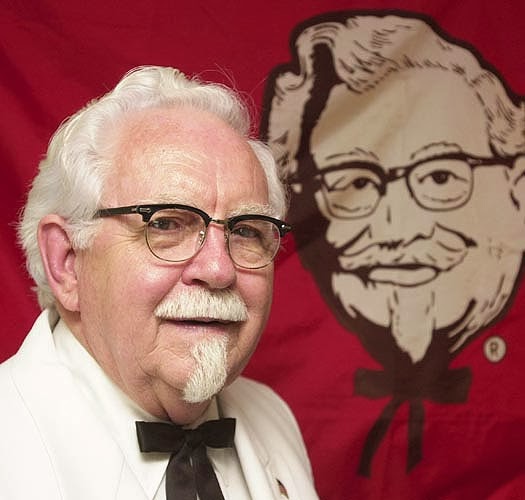
Story of Idea #1: Colonel Sanders' Fried Chicken Idea

All achievements, all earned riches, have their beginning in an idea
(Napoleon Hill)

To accomplish great things we must, not only dream but believe,
not only believe but act.” (Anonymous)

Let me cut the story short: Colonel Harland David Sanders (September 9, 1890 – December 16, 1980), who at the customary age of 65 received his first old age pension social security payment felt so dissatisfied that he decided to do something about it. Taking full responsibility for himself and with an idea in his mind he changed his life with the only asset he had – a family recipe for fried chicken.

At 65 he started to try and find restaurant owners who would pay him a share in their increased profits for their fried chicken sales that used his special recipe. 1,007 times he was told “No!” (Maybe if he were to come to me with this idea, I would probably say no too). The 1,008th said “Yes!” 9 years later he sold his business for USD2,000,000. That was a huge amount of money… the rest is history. Today his influence of idea is greatly known as Kentucky Fried Chicken (KFC).

He said, “I could have just complained about the system, cursed my luck and blamed everyone else, but I would have still been trying to live on that social security income, I had got me in that position. It was up to me to get me out.” If he never got the idea, take the action, persevere in the midst of 1,000 rejections, relentlessly achieving his dream – we will probably never taste his famous fried chicken. I will never his great idea. “One sound idea,” writes Napoleon Hill, “is all you need to achieve success.”

Lord, Give Us Today Our Daily Idea(s)

Top 10 Most Read Idea(s) Last 7 Days

Idea-Labels

Thinking Creative Question Action Change Your Life Essential Thinker Series Focus Positive Secrets of the Millionaire Mind Harv Eker Success Attitude Choice Learning Nurture Creativity Play Mindset Perspective Time Experience Habit Observation Curious Different Failure Hardworking How-to Generate Ideas Imagination Problem-Solving Wealth 12 Rules for Life Children Inspiration Jordan Peterson Relax Rich Break the Rules Change Perseverance Reading Risk-Taker Seeing Albert Einstein Barriers to Creativity Confidence I Wonder Series People The Subtle Art of Not Giving A F*ck (Mark Hanson) Connection Happiness Money Possibilities The 7 Habits of Highly Effective People Thought With Winning In Mind Asking Books Character Characteristics of Creative Person Is Technology Changing Our Brains Knowledge Practical Process Writing Believe Challenge Childlike Criticism How to Choose Optimism How to Nurture Your Child to Be Creative Innovative Listening Purpose Relationship Responsibility Story of Idea Thomas Edison Value 7 Climate Facts You Need to Know Communicate Control Enjoy Freedom Fun Idea-Quote Meaning Mistakes Open Mind Opportunity Optimistic Original Resourceful Roger von Oech Talent As A Man Thinketh Combination Commitment Discovery Don't Give Up Dream Energetic Environment Friendship Genius Give Up Growth Leonardo da Vinci Picture Playground Quiet Space Random Reason Start With Why (Simon Sinek) Steve Jobs Understand Walk Wisdom Yew Kam Keong Ability Ambiguity Behavior Crazy Daydreaming Decision-Making Example Facts about Creativity Faith Fear Feeling Goal Hearing Humour Improvement Independence Intuition Isaac Newton Lead Love Motivated Nature Non-Conformist Passion Potential Respect Savor Life Self-Image Stephen R. Covey The Power of Habit Word Alternative Application Awareness Common Blocks to Creativity Conversation Discipline Dynamic Emotion Encouragement Expectation Feedback Flexibility Idealistic Jack Foster Leader Logic Mindful Music Negative Performance Persistence Physical Reinforcement Result Right Answer Sixth Sense Society Talking The Human Body Tony Buzan Vincent Ryan Ruggiero Vision Adventurous Appreciate Attention Be Yourself Beautiful Christopher Columbus Conscious Daring Desire Edward de Bono Empathy Excuses Exercise Financial Galileo Goodness Hardship Help Henry Ford How to Be Innovative Humble IQ Jesus Kindness Laugh Let's Get Started! Memory Mental Rehearsal Michael J. Gelb Multitasking Nicolaus Copernicus Patient Pen and Paper Planning Power Praise Prejudice Proactive Progressive Quality Reality Recording Rejection Routine Sharing Simplicity Sleep Social Media Stand Firm Starbuck Stimulate Strength Stress Studying The Internet Theology Think like A Fool Touching Unpopular Usefulness Victor Hugo What If Win-Win Zig Ziglar 6 Common Creative Killers 9 Types of Intelligence A. Samad Said Affirmation Alexander the Great Aristotle Association Assumption Austin Kleon Balance Benedict de Spinoza Benjamin Franklin Bette Nesmith Graham Bill Gates Blessing Brainstorming Business Carpe Diem Chaos and Order Cicero Colonel Sanders Compliance Concentration Contribute Copernicus David Hume Descartes Desiderius Erasmus Development Diversity Don't Try Download Drug Elaboration Eleanor Roosevelt Enthusiasm Error Ethics Eurika Experiment Explore Extrovert Fluency Francis Bacon Free Book Generalist Giving Back Heroes Hopeful Hormones How to Spark Your Creative Mind How-to Maximizing a New Idea Howard Schultz Hunting Illustration Information Integrity Intention Interruption Introvert Investment James Webb Young Jason Mraz Jean-Jacques Rouseau Jim Carrey Jogging John Locke Jurgen Wolff Juxtapositions Legacy Leon Ann Mean Leon Trotsky Light Liquid Paper Machiavelli Management Manifestation Manipulation Marcus Aurelius Mark Zurkerberg Martin Luther Marty Neumeier Maturity Mental Mihaly Csikszentmihalyi Mind Maping Miracles Mission Statement Modeling Money Blueprint Mood Move On My Top 17 Book on Innovative and Creativity Lists Navigation Skills Niccolo Machiavelli Offline Ontology Ordinary Pablo Picasso Pain Paracelsus Paradigm Paradox of Creative People Parenting Passive Income Peace Perception Philosophy Plato Political Practice Priority Privacy Procrastination Productivity Promote Pythagoras of Samos Rational Rebellious Receiving Reformer Rene Descartes Resilience Resource Myopia Rest Reverse Robert Korn Running Safe Saving Say No Scientific Method Scott Belsky Self-Gratification Selling Seneca Skeptic Slow Down Smelling Social Skills Socrates of Athens Soichiro Honda Specialist Spider-Man St Anselm St Augustine of Hippo St Thomas Aquinas Steal like An Artist Stubborn Suffering Synergize Tasting Technology Thales of Miletus The Creative Environment The Empiricist The Mozart Effect Thomas More Tok Nan Toy Tradition Truth Uniformity Unique Universe Unorthodox Volunteer Walt Disney Wildlife Wonder Xenophanes of Colophon